Friday, April 8, 2016

Giants Castle update by Jeremy Williamson


Lana and I, with our birding buddy, Gordon out on holiday from Scotland, as well as Dirk Glado from Germany, old friends, had  included Giant’s Castle in our birding itinerary.

En route from Durban and close to Giant's Castle we encountered numerous Amur Falcons (aka Eastern Red-footed Kestrel)

Female Amur Falcon

Male Amur Falcon

Bye !


The road within the Park, dramatically better than the Provincial road in, badly pot-holed, take care !

The variety of species normally encountered in the camp and generally in that montane biome, plus my having secured a booking at the old Vulture Hide, bode to our having some good photographic opportunities whilst visiting Giant’s Castle Game Reserve.

Well it wasn’t to be; The extended drought severely impacted on the bird populations with many entering last years breeding period with inadequate food resources.  The numbers and variety of birds during the entire 6 week birding excursion were definitely far less than expected.   

Early morning arrival at the hide - packed breakfast from the Restaurant in lieu of their full Brekka

Surprisingly we had no vultures land and feed at the old vulture hide where we were expectantly waiting, cameras a ready! 

Gordon and Dirk

Lana becoming the avid birder

This despite my bringing smaller meaty bones especially cut for me from my local butcher, I thought it to be a Vulture treat, alas not, but the Crows and Ravens were most appreciative.

White-necked Raven

White-necked Ravens

We did have a few other birds arrive

Dark-capped Bulbuls

Familiar Chat

Speckled Pigeon


Red-winged Starling

Jackal Buzzard

We had a Cape Grey Mongoose arrive in order top purloin some of the tucker.


Then the guys who would not come and sample our offerings !

Cape Vulture looking at our offerings sideways

Yellow-billed Kite


The light was against us, what with a storm brewing, we decided to leave early afternoon


A short distance from the hide, a flush toilet has been constructed. A welcome addition.


Giant’s Castle Game Reserve’s Camp follows closely behind Thendele Restcamp in the Royal Natal National Park in by opinion as an ultimate Drakensberg vacation destination. The rooms are well appointed and in better repair than any of the other Ezemvelo KZN Wildlife’s rest-camp's accommodation. The mountain view chalets all have views of the recumbent 'Giant". Here is a reflection of what guests gaze upon when staying at the Giant's Castle Lodge.


The grounds and gardens are well maintained and these are home to a plethora of birds and Dassies too (Rock Hyrax)

Reservations at Giant’s Castle are on a bed and breakfast basis, despite all the units being self-catering. I guess this helps the restaurant substantially to be viable. At breakfast, which was delightful, I had a look at the menu for lunch and dinner, that which was offered seemed to be an excellent variety and well priced too.

With check-in from 14h00 and the last guided experience at the San Rock Art shelter and diorama at 15h00, we hastened to put all our perishables in the fridge, grabbed our binoculars and cameras and off on the relatively easy hike to see this legacy of old.

Loads of Proteaceae on the slopes

En route, Malachite Sunbird, Ground Woodpecker were specials and then in and through the dank canopy forest situated just below “Main Caves”. A community and accredited San Rock Art guide was there to meet us and led us through the enclosure to the site.


The enclosure is to keep vandals out of the precinct, a fair bit of damage to the paintings and graffiti  in various forms is evident.

Viewing structures to better view the art paintings

The diorama set where these folk would have lived, is an excellent idea.


Diorama of a San family

Some of the extensive, but rather faded art work

Shamans, hunters and eland

From the shelter one is able to look down onto the Bushman's river and across to Giant's Castle Camp.

The rolling foot hills of the uKhahlamba Drakensberg Park and the Bushman's River


The Giant's Castle Camp on a level section of the hillside


We chose to follow the river side path back to camp.

The hill housing the "Main Caves" shelter


Some delightful plants on the way.

Wednesday, April 6, 2016

Wakkerstroom Birding– Jeremy Williamson


South Africa’s birding hotspot, Wakkerstroom is a destination where the birding is really excellent. This is primarily a high veld grassland biome, along with some wetlands, mountains and wooded valleys, offering habitat for a wide diversity of our avian species.

Wakkerstroom town close to one of the wetland hides.

Ideally located mid-way between Durban and the Kruger Park / Johannesburg, which suited our birding itinerary perfectly. Our good friend out from Scotland, Gordon, with Lana and I, had planned an extended birding trip starting in Durban, through Zululand and on to the Kruger National Park.


There is a variety of Bed and Breakfast accommodation available in and around Wakkerstroom, we opted for the self-catering chalets at Bird Life, just a few kilometers out of town.

We had mixed weather whilst there, dramatic cloud effect before the rain.View from our chalets.
Hiking to one of the hides

Wakkerstroom is a small farming community town with limited shops. The grocery stores were quite adequate for basic supplies. The town has some intriguing craft / antique and cheese shops. All a bit Olde Worldly.

Typical of the architecture

But then Wakkerstroom is all about birding and it's specials such as this Botha's Lark

Botha's Lark

Nine of South Africa’s 11 endemic bird species are to be found here ! It is knowing where these birds secret themselves in this area, being the key to a successful visit. In order to ‘tick’ a broad spectrum of the local specials, a guide is essential in my opinion, especially if you have limited time there. 

We were to arrive late afternoon with only one a full day in the area on the following day, departing early on the next, rather limited for birding the area properly. Gordon, Lana and I were fortunate to have an excellent local guide, Lucky, recommended by Bird Life SA, who very capably led us to virtually all the species we were keen to see.

Out with the scope for some sightings, this was Denham's Bustard at quite some distance

The wetlands have an array of hides, and for those days without a guide, these afford excellent possibilities of finding the water birds and waders.  


A 'float' of Red-knobbed Coot

How many species can you ID here ?
There have been around 370 different bird species ticked for the area. We identified 91 and heard another four in the limited time of our visit, mind you, some were mega-ticks in my book and a few new ones too!

Some of the more special birds we were fortunate to see;
Southern Bald Ibis quite a few too, Maccoa Duck, Montague and African Marsh Harriers, African Snipe, Eastern long-billed Lark, Rudds Lark,


Rudd's Lark

Long-billed Pipit

Botha’s Lark, Red-throated Wryneck,


South African Cliff Swallow, Pale-crowned Cisticola, Wing-snapping Cisticola, Yellow-breasted Pipit, Denham’s Bustard and White-bellied Korhaan.

A pair of White-ballied Korhaan which had chicks too

Grey Crowned Cranes and Spur-winged Geese
Greater Striped Swallow, we managed some close sightings

Common Waxbill

The majority of the birds we found  were mainly at a long distance for the equipment we have, allow oneself more time if capturing these rarities on camera is a priority. This venue come highly recommended.

All photographs by Gordon MacKinnon, Jeremy and Lana Williamson

Tuesday, April 5, 2016

Kamberg Nature Reserve – Game Pass Shelter by Jeremy Williamson


Arguably the best preserved San Rock Art is to be found high up in a sandstone shelter in the foothills of the uKhahlamba Drakensberg Park within the Kamberg Nature Reserve. An area with the greatest concentration of these paintings which date back over a wide expanse of time with some possibly painted nearly 4,000 years ago!

The paintings are in the many recesses below the sandstone massif

Lana and I had been wanting to visit this site for ages, so we made a family week-end of it with my brother as well as Judy and Stan, his sister in law and her hubby. What fun!


The camp at the Kamberg Nature Reserve has 5 reasonably well appointed 2 bed chalets. 

2 bed chalet Kamberg

Each unit with own kitchen and private bathroom en suite with the kitchen having a 2 plate hob and microwave as a stove. Large fridge / freezer.


Two single beds, a fireplace – a necessity in winter,  and a freestanding braai (barbecue) off the veranda.


These look out over the lush green lawns, on down to the Mooi River and across the the grassed, granite / sandstone mountain beyond.


Cottage accommodation at Kamberg Camp - "Huntsman Cottage"


Set slightly away from these resthuts is a 3 bedroomed cottage sleeping 6 . This has recently had a soft refurbishment on the interior


Large kitchen with stove, microwave, fridge / freezer as well as a separate freezer  and pantry

Three bedrooms, 2 toilets, one in the bathroom, a large lounge / dining room with fireplace.


Bedroom off dining area, mountain view

Bedroom, garden view

Main bedroom, mountain view


Kamberg, had a trout hatchery, now decommissioned due to Trout being an alien species which has been displacing the indigenous fish, no longer acceptable to the Conservation authority. Trout are still to be found thriving in these mountain rivers and provide excellent sport for the fly fisherman.


My brother Tim out to catch a fish or two, 3 per person per day on the purchase of a rod fee.

The camp will only allow guests to access Game Pass Shelter accompanied by a guide, presently at a fee of R50 per person. Lana, Stan and I followed our guide on the well maintained pathway which in the main was on a gently contour gradient upwards, then we came to the base of the massif, and the climb really started. 

Taken from the depths of Waterfall Cave, note the water droplets !
Rock and some concrete stairs had been placed to make the ascent easier, well, we needed to catch our breath regularly.  Stan found the walk challenging and decided not to continue after ascending a particularly steep section, not an easy one for the elderly. Lana and I are fortunate that we hike fairly regularly, but this was still a challenge. 

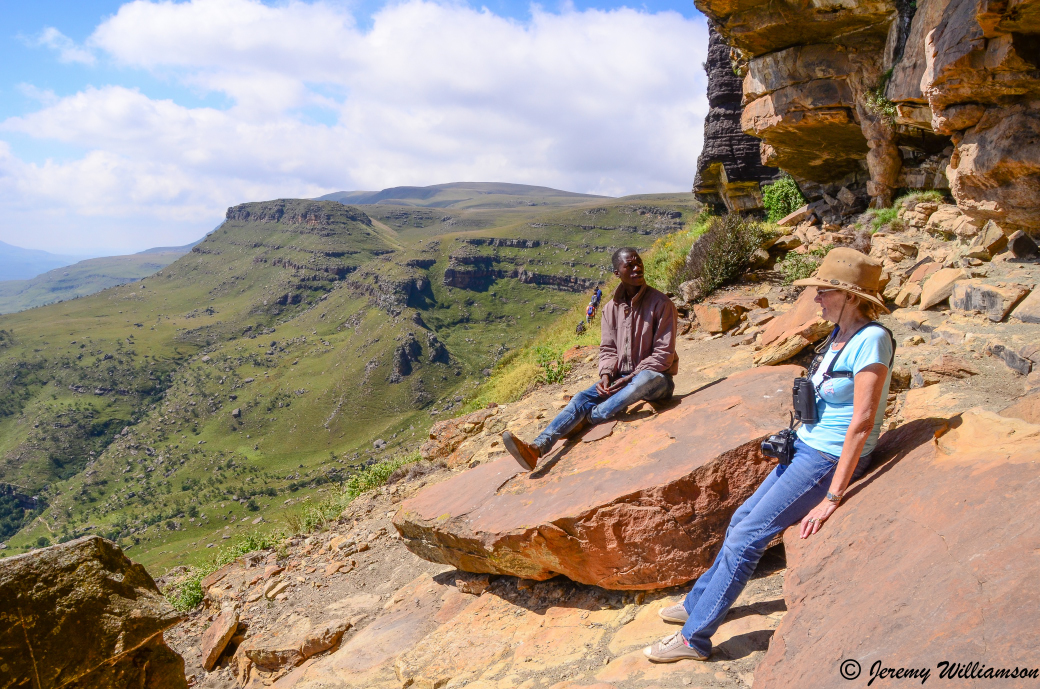
Lana recovering with the community guide.
Claimed to be a 3 hour round trip hike, we did it in 3,5 hours!
Despite the excursion the visit was  certainly well worth while. The rock art is really well preserved, with the colours still really bright. Not like so many of the sites we had previously visited.


The principal panel. Eland, hunters with legs widely spread depicting them running, and then the Shamans cloaked in Karosses.

What makes this shelter so valuable a find, is the one painted panel depicting the transformation of one of the persons being transformed from man to Shaman. Here he is shown holding the Eland’s tail which initiates the transformation, then in change and finally transformed to be a Shaman, the orange figure on the right with the head of an animal.

The "Rosetta Stone" of San Rock Art, this depiction gave the researchers the insight to interpret San Rock Art


All photographs by Jeremy and Lana Williamson