Saturday, May 3, 2014

The Good, the Bad and the Better, an Easter Tour – Keith Marallich

I had two very charming ladies with me on tour for nine days, which included the Easter weekend – a kindly grandmother from the U. S. A. had decided to treat her 13-year old grand-daughter to a safari of the Kruger Park and Arathusa Safari Lodge in the adjacent Sabi Sands Reserve.  Lucky grand-daughter! We headed out to the Panorama Escarpment and the Lowveld from Johannesburg on the Thursday before the long Easter weekend, and the roads were very busy.
I was quite concerned about this tour as we had been informed a few months ago that the current restaurants in the various camps in the Kruger Park would be closed and that new, improved dining establishments would be in their place. We were initially led to believe that the new restaurants would be up and running by about March. During March (and now getting closer to departure) we received further notification that there were no clear dates for the opening of these restaurants, and that this event could be delayed by months, varying from camp to camp! I could just picture us eating our meals out of tins, with dry bread and maybe paper plates on our laps to lend a touch of class!
To make matters worse and add to my concern, these two ladies had a “wish-list” of animals they HAD to see, and among these were cheetah and bush-baby. I must also say that during my many exchanges of correspondence with her, the grandmother was very concerned about danger and diseases, from malaria to rabies and everything else in-between - as well as animals possibly being able to get into their rooms, who would escort them from the vehicle to the rooms, how safe was it, etc, etc. I am happy to say no-one became ill, no-one was attacked, as far as I know no-one contracted any disease, no-one had to eat out of tins or off paper plates and a fine time was had by all.
Now in keeping with my title, so shall the content be…
The Good:
(a)    The weather of course. Daytime temperatures varied between 32º and 37º C every day. We also experienced clear blue skies for all of the days, except for one day which was overcast with a very slight drizzle.


(b)   Wildlife and bird sightings were very good for most of the time, in both reserves, with fairly close-up viewings to be had. Especially prolific in the Kruger Park were baboon sightings (and who can’t sit for hours enjoying the antics of baboons?), lots and lots of Lilac-breasted Rollers and other birds, and then of course elephants – more than enough, almost around every bend in the road. Elephants were so often seen that we tended to eventually just drive past them without too much interest – unless they were blocking the road.


(c)    What I particularly enjoyed were the birds inside the camps and at Skukuza, even a Rock Monitor close to my bungalow in the middle of the day. I don't take mid-day naps, I prefer to sleep at night. In the day when not driving, I rather prefer to walk around the camp with my camera in the hope of seeing something worthwhile to photograph.


(d)   There was also a dead hippo in the Sabie River just below the bridge downstream from Lower Sabie camp, which had attracted a few crocodiles, and this spectacle was pretty interesting – just a little too far out of camera range. Crocodiles were taking a mouthfull of hippo meat, and then going into their "death-roll". Crocodiles cannot chew, so they bite a chunk of meat, and with the vigorous roll of their body, usually manage to get a sizeable piece of meat separated from the carcass, which they then swallow whole. 


(e)    A hyena had made her “den” in a culvert on the main road between Satara and Olifants and a young pup, which had no fear of vehicles, was quite happy to pop his head (and the rest of him) out every time someone stopped here. I took many photos of this chap, but alas, he was the only one to show himself at this culvert – and we visited here twice. In the Kruger Park it is not unusual to find that hyena's had made a den in the culverts under the roads and they tend to use these same dens on a regular basis.


(f)    A good clear sighting of a cheetah (one of the animals on their “must-see” list) near Satara, but too far from the vehicle for a decent photo, but what a privilege to see a cheetah in the wild. Ten minutes after seeing the cheetah, we came upon two lionesses lying in some shade – this all during the mid-morning. Another animal on their wish-list that we saw was a thick-tailed bush-baby – on two consecutive evenings – at Olifants Camp whilst we enjoying dinner. I did manage to light him up by torch-light (for my American friends, a torch is what you call a “flashlight”) so we had an excellent view of him on both occasions. 


(g)   The Restaurants of Lower Sabie and Satara. We enjoyed breakfast at Lower Sabie Camp on one of the hottest days of the tour, when the temperature was up to 37º C. For those who don’t know, Lower Sabie now has a fully operational Mugg & Bean Restaurant, with their full menu items available. Here I had the best coffee that I have ever had in the Kruger Park – the barista even knew his latte art! The Mugg & Bean at Satara had only opened the day before we arrived, but alas, this barista’s latte art skills weren’t up to scratch – he’ll improve, he only had 24 hours of practice. The Mugg & Bean On-the-Go at Satara had the full on-the-go menu items available as had the Debonairs Pizza, but the Mugg & Bean Restaurant only had three items from their main menu available at that stage. (I am aware that they too, just like Lower Sabie Camp, are now fully operation, having opened their full menu two days after our departure). Olifants and Letaba Camps will shortly be up and running. For those of us living in the towns and cities of South Africa, this is no big deal – we all know Mugg & Bean and Debonairs, but for those of us that regularly visit the Kruger Park, what an improvement Mugg & Bean is on what used to be on offer.   


The Bad: 


(a)    This has to be the roads in the Mpumalanga Province. In South Africa it is a fact that we drive on the left side of the road, but in the Mpumalanga Province we drive on what’s left of the road! In the middle of the town of Graskop there was a pothole as big as a Volkswagen Beetle, the road between Belfast and Lydenburg is still as bad as was reported on TV recently and the roads in the vicinity of Acornhoek are, to use a phrase popular with politicians in South Africa, a “challenge” 


(b)   Lake Panic, one of my favourite spots in the entire Kruger Park was a disappointment. There had been a tremendous amount of rain in the Kruger Park during the rainy season, particularly the last few months and there was just too much water at this hide. Those dead trees and grasses on which the birds had always perched, and the sand-bank that was visited by crocodile, hippo and an array of other wildlife, was under water. The result was that birds were only seen in the undergrowth in the far distance – way out of reach of my lens. This is the same issue that I experienced at the Sweni Hide in the Satara region - too much water. Hopefully the water subsides during the dry months and we can again experience the tranquility of these two hides.


(c)    Breakfast at Satara. (How can this be bad, it was talked up in the Good section above? Ed) Well, I made a mistake of asking the young lady to choose the table and she chose one in the sun. I tried subtlety to get her to change her mind and to choose the shade, but she was having none of that, so in the sun it was. We waited some time for our order, (remember, this was on the Saturday of the Easter Weekend, and the camp was busy) and as we waited it got hotter and hotter. When she finally wanted to change to the shade, all the tables were already taken and customers were queuing to get in (I told you Mugg & Bean was a major improvement – I had never before seen anyone in a queue at a restaurant in the Kruger Park for breakfast). The upshot of this was that we finished our breakfast in a hot, sweaty, uncomfortable mode, but the lesson was learnt – I will in future call the shots as regards seating.


(d)   A traffic log-jam on the main road between Lower Sabie and Skukuza, which took me about 45 minutes to pass. Now I was aware that every bed in every camp in the Kruger Park had been taken for this long weekend and that the authorities had imposed a gate quota at each gate, so the park was full, very, very full. This traffic jam was caused by a leopard, lying in the deep shadow about 40 metres off the main road, with only a flash of white from its belly visible and all and sundry trying to get a better look at it.


(e)    Dinner at Skukuza on both nights we were here. Skukuza still has the old restaurant and Take-Away section operational, both of which were very poor in quality and service, but we survived. I can’t wait for the new restaurant to open here. This below is an extract from a SAN Parks media release: “The Skukuza Selati restaurant will be operated by Ciao! and are expected to start operations in December 2013 and the main camp restaurant and take away will be serviced by Cattle Baron and Bistro. Operations will start in May 2014 because of extensive refurbishment”. When we were there the Selati Restaurant was closed and it did not seem as if any work was taking place or had been done here, but maybe both will be up and running at the same time in the near future.


(f)    The weather on one of the days was overcast, with a slight drizzle, and this day sadly had to have been the one full day at Arathusa! Do you know what a difference a photo makes when taken in good light as opposed to one taken in shade? 


The Better:


(a)    This has to be Arathusa Safari Lodge. I really urge any person, but particularly an international visitor who may only ever do a safari once in their life-time, to visit an authentic private lodge/game reserve - it can be any lodge in the Sabi Sands Private Reserve, but Arathusa is well-priced, comfortable, with great game drives and is excellent value. You will not get better, close-up sightings of wildlife than in the Sabi Sands.


(b)   The small lion pride in the riverbed in the late afternoon, which consisted of two females and three cubs, quite inactive, but still a great sighting. Man, those cubs are cute.


(c)    The leopard we saw in the early morning (which sadly was also the only leopard we saw during our stay here), but alas, this was the day that it was overcast and rainy. I must just add that speaking to other guests at the lodge (those that were not on our vehicle), they did see different leopards at different times, but our guide was intent on showing us the Big 5, which he succeeded in doing. However, for me personally, I would rather see a variety of leopards than, for example, a rhino, but hey, that’s just me. I was hearing from other guests that they had seen two leopards together (unusual, to say the least), a female with two young cubs and another, older male on his own – and these were only during the one drive! As far as leopards go, we only saw one young male.


(d)   The hyena den (this one a real den, not a culvert under a road as in the Kruger Park, a real den in an old abandoned termite mound) where a mother and her young cub interacted beautifully. I could have sat there the whole day, but hey, again, that’s just me. Unfortunately, this was the same overcast morning as the leopard sighting.


(e)    A murmur, band, pack, whatever, let’s just say a group of dwarf mongooses. These cute little guys were atop a termite mound when a tree squirrel ran up the one side of the mound. This caused the mongooses to bound (Do dwarf mongooses really “bound”? Ed) over to the edge of the mound to see what the squirrel was up to. They did this just because they are inquisitive – a tree squirrel is no threat to the mongooses. 


Hereunder are some random photos taken at the Kruger Park and Arathusa – enjoy.


This female baboon was in the Sabie River slaking her thirst.


These lads were grooming one-another and were obvlivious to the nearby humans


Does one have to say anything?


The thoughful one


This kudu visited the water about five minutes after the baboon


The young hyena near the "culvert" den in the Kruger Park


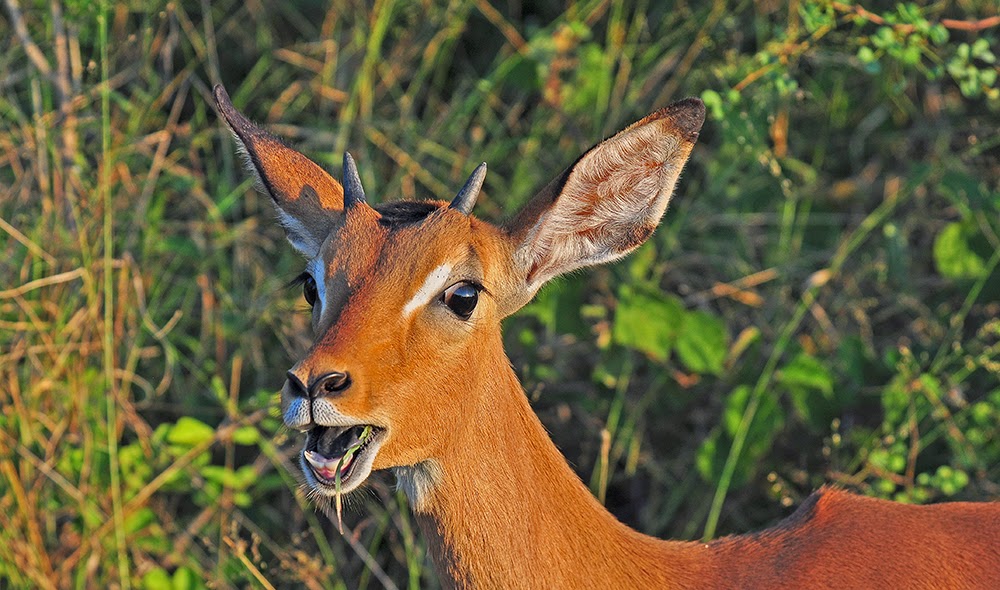
A surprised young impala


The Rock Monitor inside the Skukuza Camp


Whilst waiting for the gate to open just before 06:00 at Satara Camp - I photographed this from the vehicle


A Black-collared Barbet inside Skukuza Camp 


A White-backed Vulture in the Kruger Park


A Red-billed Hornbill


One of the many Lilac-breasted Rollers that I photographed


A male Ostrich in the Satara region


A European Roller - cousin to the Lilac-breated Rollers


A Brown Snake Eagle - note the yellow eye, common to all snake eagles


The small lion pride at rest on the first afternoon at Arathusa


The young male leopard at rest in an open area


and then heading off on a stalk


This when he was in a tree, after stalking tree squirrels


The mom and youngster at the den in the Sabi Sands


Gentle play


The youngster having a closer look at us


A young male in pose mode


and in bored mode


This is the rhino we saw in lieu of more leopards - Arathusa's other vehicle is in the background


The Dwarf Mongooses having a look at the squirrel - which is not in frame, it was at this stage at the base of the mound


Just a zebra

Wednesday, April 9, 2014

Golf Special at Fordoun Hotel & Spa
 Enjoy two nights at Fordoun, and get two rounds of golf at two of SA’s finest courses. Midlands, KwaZulu-Natal.

Package includes :

  • Bed & Breakfast for two nights in one of the Luxury Suites
  • Unlimited use of the Spa Facilities
  • Golf at Gowri Golf Course (18 holes)
  • Golf at the newly renovated Boschoek Golf Course (18 holes)

Weekend Rate (Friday & Saturday, School & Public Holidays)
Single - R 2 880.00    Double - R 4 760.00


MidWeek Rate (Sunday to Thurdsday)
Single - R 2 880.00    Double - R 4 760.00


Contact Far & Wild to Book NOW!   farwild@iafrica.com


Tuesday, March 25, 2014

EASTER SPECIALS
at Elephant Rock Lodge and Springbok Lodge, Nambiti Private Game Reserve, KwaZulu-Natal

Contact us NOW to make your booking! farwild@iafrica.com


Elephant Rock Lodge Special
 Elephant Rock Lodge is superbly sited charming boutique safari lodge overlooking a
waterhole, set high on the sides of a hill in the Malaria free Nambiti Private Game Reserve offering accommodation for up to 10 guests, which includes one family unit.
R 1,695.00 per person sharing per night. Valid from  21 March 2014 - 4 May 2014


Springbok Lodge Special
 Springbok Lodge in the malaria free Nambiti Private Game Reserve, offers the perfect safari experience. Beautifully appointed tented suites, excellent service, superb cuisine and prolific wildlife. Views from each tent allows guests expansive views of the bush. 
R 1,695.00 per person sharing per night.  Valid from  20 March 2014 - 5 May 2014

Contact us NOW to make your booking! farwild@iafrica.com

Thursday, February 20, 2014

My Visit to the Lions Valley Lodge, Nambiti - Keith Marallich

I had convinced a family that a three-day tour to the Nambiti Game Reserve would be a better option than what they had wanted – and at almost the same cost, so here we were in mid-February making our way from Durban to Nambiti. For those of you who don’t know, the Nambiti Game Reserve (http://www.nambitireservations.co.za) is not too far from Ladysmith, roughly a three-hour drive from Durban. At the conclusion of the tour, the family were grateful that I was able to get them to change their minds – they thoroughly enjoyed the experience in this productive reserve.

The lodge that I was lucky enough to secure for us was the Lions Valley Lodge, situated in the heart of the reserve and rated a 5-star game lodge. This is a lodge with ten suites (see what I did there? Suites, not rooms) and all suites have their own theme. These themes are Africa, Bird, Livingstone, Ndebele, Nguni, Romance, Safari, Savannah, Zebra and then the one allocated to me, the Spaza Suite. Now I don’t want to go into too much detail about the lodge – this has been covered in two previous blogs by my colleagues, Lisa and Jeremy. Please see http://farandwild.blogspot.com/2011/04/lions-valley-lodge-nambiti-game-reserve.html and http://farandwild.blogspot.com/2011/12/lions-valley-lodge-nambiti-private-game.html for their input. In both these blogs they describe the lodge in fair detail, BUT both of them have a comment on the Spaza Suite (and very little, if any, on the others – why?). It seems it is left to me to have my say!

The Spaza Suite is identical in size, configuration and layout to all the other suites at the lodge, but has, in my humble opinion (and I am not an interior decorator, I am a guide) some “brave” decor. This suite consisted of a large bed, a walk-in closet area, two baths, two vanities, four showers (two inside and two outside), a lounge, outside deck, bar fridge, coffee station, two chandeliers constructed of cola bottles and two overhead fans...and I am one bloke! Wickipedia tells us that a “spaza shop” is an informal convenience shop/business in South Africa, usually run from home. They also serve the purpose of supplementing household incomes of the owners, selling everyday small household items. These shops grew as a result of sprawling townships that made travel to formal shopping places more difficult or expensive. So, now we have the definition, and hereunder are some photos of the suite – you make up your own mind...

A section of the Spaza Suite. The door to the right is to the walk-in closet.


One of the lounges in the suite.


Some of the decor


And one of the desks


The two baths, with the double inside shower beyond them and then the double outside shower beyond that.


The double vanities.
 
A cute reading lamp.
 
One of the two bottle chandeliers.

As for our guide, Nolan, what an excellent guide, his easy manner with the guests, his knowledge, enthusiasm and easy demeanour makes him an asset to the lodge as does the remainder of the staff, and even though it is unfair to single out any of them, a special mention to Charlie (who made sure that everything ran smoothly at the lodge and was never seen without a smile on his face) and Joe (who kept our food coming and our drinks served).  An extra special mention must also go out to Mango. Who is Mango, I hear you ask. Well, Mango is a semi-tame Banded Mongoose who has made her home at the lodge. I don’t know her history, but banded mongooses are not found in this part of South Africa and are animals that occur in large groups. She was very cute and very active. I struggled to take a decent photo of her as she was on the go all the time, if not hassling the guests (and particularly the ladies), she was scurrying about the lodge or outside digging for grubs or looking for insects. I did have her quiet for about all of twenty seconds, stroking her belly and behind her ears, but she wanted to reciprocate and her nails are sharp! 

Mango drinking from the pool.


And then scurrying away.


Taking a 10-second breather!


Where to next? Who can I hassle?


Ahh, first more water.
 
Game viewing was good, with a wide variety of animals to be seen. We saw a variety of animals and in fairly large numbers giraffe, zebra, wildebeest, kudu and once a large herd of eland. What was probably my highlight was the lion we were tracking on one of our morning drives. We had left the lodge early, heard the vocalising of the animal and started following. Another vehicle had sight of the animal from one of the hills, quite far away, and directed us to it via radio. The lion was on the road and we started to follow at a fairly short distance. Lo and behold, the lion took us back, right through the Lions Valley Lodge, between the staff quarters and the guests’ chalets and out the other side. It in fact crossed the path that I would take from my suite to the lounge area. Luckily one is transported from your suite to the central area by golf cart – just a quieter game drive! Anyway, the lion passed through the camp and then posed for some photos about 180 metres beyond the camp. Hereunder some lion photos and then some of the general game and birds...

The lion that wandered through the lodge confines.


Throwing out a challenge: "I'll walk where I want!

A Gemsbok (also called a Cape Oryx).


Zebra pose.


Black-backed jackal.


Steppe Buzzard - there were plenty of these about.


Part of the Eland herd in the grasslands.


A Kudu in the tall grass.


A male Amur falcon - the females are striped. There were even more of these birds, literally hundreds of them.


Some hippo activity in the late afternoon.


And to end off with, an African fish-eagle in fly-past.

Umzolozolo Private Safari Lodge in the Nambiti Game Reserve

The lucky winner of the 2 Night Stay at Umzolozolo Private Safari Lodge in the Nambiti Game Reserve: Matthew Peters

Imagine our excitement when I saw my name as the winner of the Far & Wild Safaris competition. A two night stay at the Umzolozolo Lodge at Nambiti Game Reserve, and we could not wait to go. We decided that two nights was not enough and booked an extra night through Far & Wild Safaris. The day of our departure dawned, grey and wet, but that did nothing to dampen our spirits, and after what seemed a remarkably short trip we were at the entrance gate to Nambiti. A few quick formalities and we off to the guest parking area where we were picked up by Chris, who was to be our guide for the next few days. Jeremy of Far & Wild Safaris had told us that he had managed to secure the presidential suite and he was not joking. Our chalet was huge and luxurious with a king sized bed, a separate dressing room, a huge bathroom with a double shower and an outside shower with a view, a big deck with a jacuzzi and a view across the reserve.
A quick time to freshen up and we went up to the reception to meet the managers Debbie and Dave. We were told the dos and don’ts, and to check on dietary requirements and then it was time to explore. Twenty four hour coffee and tea on tap, and a view from the deck that allowed us to see animals down in the valley and of course a beautiful rim flow pool.


A light lunch was soon followed by our first game drive, our target for the evening elephants, and it was not long before we found a breeding herd with some little ones. After watching them for a while, we moved off to have sundowners, shortly after we stopped the herd appeared out of the bush, obviously also wanting a drink. We hastily got back into the vehicle as the herd approached, with one young bull coming right up to the vehicle to investigate and then moved to the front of the vehicle where he found some ice that had been dropped and proceeded to eat it mere centimetres from the front of the vehicle. When he had finished his cooling snack he moved off and we were able to proceed back to the lodge for supper. I chose to try all the courses, from soup to sweets, and spent some time feeling as full as a tick. A bit more discretion would be required at future meals. The first night in the bush is a special time, and sitting on our deck we could hear jackals calling and the sound of a barn owl, a good introduction to Nambiti.


Up VERY early the next morning and off to see whatever we could. I was amazed at the number of kudu and eland we saw, and once again we bumped into the same breeding herd, this time a bigger young bull decided to investigate the vehicle, and thought that the ‘bull bar’ would make a good scratching post, and shook us all around while he enjoyed a scratch. Then it was back to the lodge for a great breakfast and time to relax after our early start.
After lunch it was off on another drive, and this time it was a lion hunt. We headed north and on the way saw a herd of buffalo, and once again numerous plains animals such as wildebeest and zebra. At last we received word that the lions has been found and off we went to see them. Two females and a big male who was very amorous. It was starting to get dark when we finally left. For the Tuesday night we had decided that we would have a supper at our chalet, and when we were dropped off at our door we were greeted with the sight of a jacuzzi ringed with candles and lamps and a table set for two. Sparkling wine in the warmth of the jacuzzi was followed by and excellent meal, with the different courses being brought by the staff as and when we wanted them. A truly romantic evening.


Another early morning drive to find black rhino was unsuccessful but once again we saw a lot of game and three large elephant bulls. We stayed well clear of these, as they were more than capable of a lot of damage. The day started clear and showed just how hot that part of the world can get.
The afternoon drive started with storm clouds threatening, and half way into the drive the sky opened and a thunder storm of note hit us, with rain pelting down and making it all but impossible to see. We did however see a black rhino, a great sighting.


The next morning, our last, we chose not to do the game drive but to relax and pack, and after breakfast we set off to Kwa-Cheetah to experience the cheetah interaction. What a wonderful experience. After a short talk we were off to see and touch a young leopard male (through the fence), and then it was off to the cheetah enclosure where we could get up close and personal. It was amazing to see how relaxed they were around us and how loudly they purred when stroked. Of course everybody had to have a chance to pose with these delightful creatures. Then it was off to see the servals and watch how they chased a toy, and the tour finished off with a visit to four teenage cheetah cubs. All in all, an experience not to be missed.


In summary, Umzolozolo Lodge was as good as any lodge in the greater Kruger area. It is small and so the staff can give that essential personal attention. The food was excellent and the accommodation very good and the staff are all very friendly and obliging. The only downside is that Nambiti itself is relatively small and so while it has large game numbers, the big five numbers are small, and so cannot give a wildlife experience similar to the Kruger lodges, but compared to them it is excellent value for money costing about a quarter of what they do. I recommend it highly and will not hesitate to visit again.
Once again I want to thank Far & Wild Safaris for this wonderful opportunity
.
 -  Matthew Peters