Wednesday, October 6, 2010

Kruger Park Tour, September 2010

I was fortunate to be the guide for clients who had decided to visit South Africa for the fifth time – and I had been their guide on the previous four occasions. These were very keen photographers, and I was in my element. Also, these clients were not focused only on the “big-5”, but were interested in every aspect of our wildlife on offer – so refreshing not to have to focus solely on only some animals! They had visited South Africa on the previous four occasions to take photographs – visit number five was no different. The only difference now between this visit and the previous ones was that they were even more discerning, so I had to keep in mind the light situation, the angle and direction of light, the time of day, and the placing of the subjects relative to this. The weather played along most of the time, but we did have overcast conditions on two of the mornings and very strong winds on one of the days. Photographers will know that lighting is the most important aspect for wildlife photography and for all forms of photography in general. The only negative (if one can call it that) aspect to all of this, is that this tour took place over the school holidays and the Heritage Day (or is it National Braai Day?) long weekend. Kruger Park was chock-a-block, with all camps full and day visitors at a maximum. These numbers of visitors notwithstanding, we had some good sightings.

We started off with three nights at
Skukuza and three nights at Satara – both good areas for game viewing in this very popular park. All the general game were seen, and including lion, many, many elephants, rhinos, buffalo, leopard, zebra, wildebeest, a whole range of antelope species, a variety of birds, etc. etc. In fact we saw lions every day, with more than one sighting per day, and on one day, as many as four sightings! Elephant sightings may have been a many as ten per day, they were so common. Compare this to some of our other parks in South Africa and one can see why the Kruger Park has such a reputation – one does not get many of these sightings in some of the other parks as you will regularly get in the Kruger. I tried to avoid the more busy tarred roads, as with this number of visitors, these were sure to be busy, so I stuck mainly to the lesser dirt roads, which were much less busy. In fact, on some of these roads we hardly saw any other vehicle at all, or else only very seldom.

- A visit to Lake Panic. Those of you who know me will know that this is one of my favorite spots in the Kruger for photo opportunities. This visit did not disappoint, and we had some amazing birding here. There was a grey heron in the nest opposite the hide with two chicks, and she kept us entertained for a long time, flying to and fro, feeding the chicks, etc. I was focusing on a goliath heron, when I heard both the female and her two chicks kicking up an awful racket. I looked up to see what all the fuss was about, and lo and behold, here was a female leopard below the tree where the herons nest was, and they were telling her in no uncertain terms that they had seem her and best she move off! The leopard took their advice and moved along the waters edge until she was out of sight. Unfortunately she was in the foliage and did not make for any good photographs, but how often does one see a leopard from a hide? The answer is of course twice – I had seen a leopard here about two years ago on another visit!


- One morning we had travelled on a quiet dirt road and had now joined the busy tarred road between Skukuza and Pretoriuskop, en route to Pretoriuskop for breakfast, when I was stopped by a guide in an open game drive vehicle. “Daar is ‘n luiperd drie kilometers af met hierdie pad” he says to me, which translates as “there is a leopard three kilometres down this road”. “Yeah, right” I think to myself. How likely will it be that this leopard, if there ever was one, will still be on the road, taking into account this guide’s three kilometers and my three kilometers of travel? Three kilometers down this road we come to a massive traffic jam, and the cause of this traffic jam is a magnificent male leopard! He is acting just as if he was in the Sabi Sands, he in unconcerned and disdainful of the many cars around. He is strutting his stuff in the middle of the road, with the odd walk to the edge of the road to mark his territory, before taking up position in the middle of the road again. The light is good, but unfortunately the setting on the tar road is not too good, but some close-up shots of his head are taken by my clients, before he wanders off the road and into the bush after a while.


- That afternoon we had some magnificent elephant, close up in very good, low light, and the clients were happy with this. Many shots were taken here. (I don’t bother with elephant shots too much – I have taken plenty in my time, but they are all just so-so, nothing that stands out, so I tend to leave them be as far a photos are concerned, let better photographers have them).
- The clients also wanted a good giraffe photo, with blue sky behind the animal’s head, as well as baboons. One game drive delivered on both, and this too was ticked-off the “to do” list.


- On our arrival at Satara, we saw a Scops Owl in a tree, perched low on a branch, very close to the reception area. This poor bird was being photographed from all angles, some photos being taken by people with their cell-phone cameras, so close was the bird! One could in fact reach out and touch him, but I suppose that he had had enough of people, as he was not there the following day. Good for him.


- One afternoon we went to the Sweni Hide, where there were some lovely yellow-billed storks and a number of waterbuck present. Again, nice light, so many photos were taken.


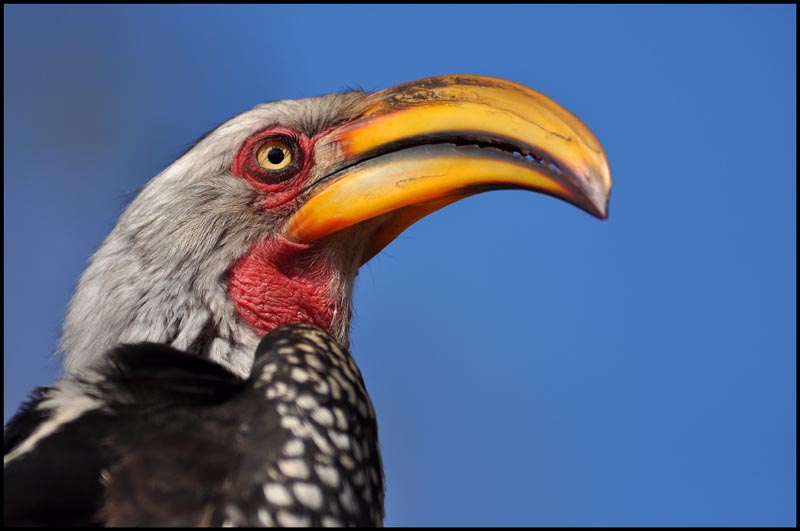
- The hide at Muzandzeni produced some lovely hornbill photos. There guys were posing in good light and seemed to enjoy showing off. Oh, and by the way, we were the only people there, so had the place to ourselves and spent the better part of an hour here. 


- At the Matambeni Hide just north of Letaba, I saw movement on the far side of the Letaba River. This turned out to be a crocodile that had either a bushbuck or impala in its jaws, and was now carrying this unfortunate animal with great difficulty to the water, where it would no doubt be having a feast. Unfortunately this was too far away for any photos, but what a sighting.


- That afternoon I was driving on the H7 to the west of Satara, where the bush had been burnt. This was a very windy day and we weren’t seeing much. Out in the burnt area I then spotted something tan, and upon closer inspection with binoculars, found that it was a caracal. This beautiful animal was totally relaxed, but just too far for any decent photos. The clients were happy; this was their first sighting of a caracal anywhere.


- On the way back to camp, just before the camp gates were to close, there was another massive traffic jam. Three male lions had decided to rest up next to the road. We did not spend any time here.


– the camp gates were about to close, and there were just too may cars. I joked that we would probably find them the next morning. And so we did! Upon leaving Satara, we came upon them at the intersection of the H1-3 and H6, boldly sauntering along the road, with a couple of other vehicles in attendance. Again, some nice photos were taken.


One has to temper a visit to the Kruger Park with the standard of the camps, the quality of the restaurants and the level of service of some of the staff, but all in all, this was a good tour, and I will certainly be back at the first opportunity.


With all these sightings and photographic opportunities that we had, there were some really good sightings that stood out:


- One really good male lion on the S21 towards Lower Sabie. He was coming from the left of our vehicle, and when he got close to the vehicle, stood still and posed for a while before moving off directly in front of us, with us being the only vehicle there. This was one of the mornings when there was no sun, so the soft light was not as dramatic as it could have been, but good nonetheless.

Thursday, September 30, 2010

Asara Hotel - Stellenbosch

Wasn’t I the lucky one recently?

I was invited to a Relais & Chateaux workshop that was held in Durban a while back. There were a number of member properties exhibiting at this workshop, all superb properties in South and Southern Africa. I always try and attend these events, as one is almost always bound to learn something here, and this event was no different – a property in the Kalahari, Tswalu, which I had always been interested in, had set out their programme for 2011, which I realized may suit some current clients. Two things immediately caught my eye – if you stay for four nights there is a complimentary air transfer to/from either/or Cape Town and Johannesburg to the property, and if you confirm three months in advance, you are guaranteed your own private ranger and vehicle. I have since discussed this with these clients and it seems as if they will be spending some time there next year.


But more than this – as is customary at the end of these events, there is a lucky draw, with some wonderful prizes up for grabs. One always sits down with hope, and there I was, hoping for a prize of some sort. Well, business cards were drawn, prizes were handed out, and the final draw was to take place, with my name still in the bottom of the hat, as it were. So, as you are now no doubt expecting, my name comes up last, and I have won a two night stay at the Asara Wine Estate and Hotel in Stellenbosch in a de luxe room, with a complimentary dinner at Raphaels for two, as well as wine tasting for two. 


This was great, and I made plans to get to Stellenbosch a few weeks later. What a wonderful hotel. Set on an enchanting, three-century old wine estate, Asara has risen over the past seven years to become one of the Cape's most exclusive Wineland destinations.
Guests can indulge in five-star luxury accommodation, fine wine tastings, superb service, and gourmet and casual dining. All facilities boast spectacular views, with their tranquil waterside setting, backed by the grandeur of the Stellenbosch- and Helderberg mountains and vineyards, providing an idyllic backdrop.


Our stylishly decorated de luxe room had its own private terrace which offered spectacular views over the vineyards and surrounding mountains as well as en-suite bathroom facilities. The bedroom was equipped with a fully stocked mini bar, hairdryer, satellite television, telephone, tea and coffee making facilities as well as an electronic safe, with a king sized bed. We spent the one night here and did a bit of sight-seeing in the Stellenbosch area the following day. Upon our return to the hotel the duty manager had bad news for us – there was a problem with the geyser, and we would have to move to another room. And which other room? The Avalon Suite of course.


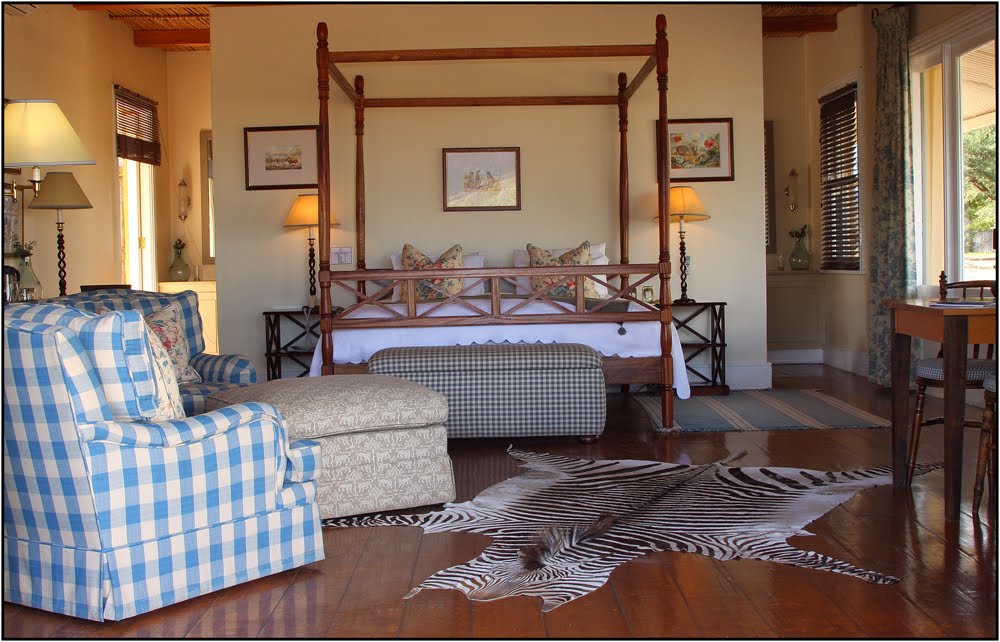
Named after Asara's most prestigious wine, the Avalon Suite offers its guest a slice of opulence. The stylishly decorated suite consists of a spacious king sized bedroom with a large walk-in cupboard, a luxurious en-suite bathroom fitted with a jet bath, as well as a private lounge with an open fireplace. Its private balcony offers spectacular views of the Estate's well-maintained vineyards as well as panoramic views of the Stellenbosch and Helderberg mountains. It is equipped with air conditioning, a fully stocked mini bar, hair dryer, electronic safe, two satellite televisions and a DVD player as well as tea and coffee making facilities for your use. Bad news indeed! This was heaven.


That afternoon we did some wine tasting there. We had a choice of tasting five wines each, and these were not the puny little wine glasses so prevalent at other estates, but proper wine glasses. I chose four reds, and a noble late harvest to call it an afternoon – all good stuff. 


That evening it was dinner at Raphaels. Asara's main restaurant offers classic European style cuisine ranging from very easy and light snacks to the finest of dishes, using only the finest and freshest locally sourced ingredients, including seafood. The environment is relaxed and informal with a touch of elegance, perfect for enjoying breakfast, lunch or dinner on the estate. This was a superb meal, complimented by delicious desserts and what other than a bottle of Asara Shiraz.


Certainly a place to go to if one has the means.


Tuesday, June 22, 2010

Kwandwe Game Reserve: May/June 2010

It was with anticipation that I left Durban to travel to the 22,000ha Kwandwe Game Reserve in the Eastern Cape in late May. This is an area that I am not too familiar with, and was keen to visit here, for a number of reasons. The main one was to see the different wildlife species, as opposed to the lowveld of Mpumalanga and the Hluhluwe uMfolozi Park species that I am pretty familiar with and to familiarize myself with those lodges that we may send clients to.

We arrived at Kwandwe, which is situated in the Grahamstown region, in time for lunch on a wet morning. In fact, we had traveled from East London to Kwandwe in pouring rain. We were transferred from the reception to Ecca Lodge, whilst there was still a fine rain prevalent, but this fortunately cleared up in time for our afternoon drive.


What can one say about Ecca Lodge? This was, as expected, subject to the same high standards as all other &Beyond Lodges that I had visited. Set in thick vegetation overlooking a dense valley, Ecca Lodge offers a breathtaking view onto an escarpment of steep shale cliffs. Expansive wooden viewing decks provide the ideal setting to soak up the bushveld atmosphere with a leisurely lunch or a sundowner drink. The Lodge’s pagoda-style corrugated iron roofs and walls of wood panelling blend seamlessly into the magnificent landscape.


Rooms are airy and open, with barely a barrier between the indoors and the African bush. Minimalist chic is the order of the day in modern, spacious bedrooms that share wraparound wooden decks with the suite’s private sitting rooms. Retro light fittings and polished concrete floors combine with shades of olive and burnt orange for a warm yet modern look. The ultra-modern bathroom, with its mosaic mirrors and glassed shower, refreshes and delights. An outdoor shower with a shiny tin tub tips a broad wink at safari tradition.


On the first afternoon game drive we watched two black (yes folks, black!) rhinos sparring over a female in some thick bush for about half an hour and then moved on. About twenty minutes later we chanced upon a female black rhino and her sub-adult calf, again in thick bush. We must have spooked her, as she took off and was running parallel to the road (and our vehicle) for about 30 -40 seconds, when she suddenly came out of the bush, straight at us! Now this was a scary moment – we are mostly all aware of the cantankerous nature of black rhinos, especially with a calf at her side. She reminded me of a steam locomotive, with all this 1500 kilograms of grey/black, puffing, angry rhino face to face with some very wide-eyed people on the back of a game drive vehicle, less than 10 metres away. She snorted and puffed, our ranger revved the motor, and a stand-off took place. We won – the rhino took her calf and disappeared, not to be seen again. Oh, and we saw three young male lions, but tame stuff compared to the rhino.


The next morning we had a very interesting interaction with cheetah. We had chanced upon a male cheetah that had obviously been feeding on a kill the whole night. This animal was ambling across the open plains with his stomach hanging almost to the ground, full of some unfortunate animal that was dinner. He arrived at a tree and started sniffing around and then scent-marked this area. I thought that he would then move on but he didn’t – he started calling. This went on for quite a long time until he moved off. Two minutes later he was back, with more calling and sniffing, which then gave us the idea that he was onto something. All of a sudden he took off, with us in hot pursuit in the vehicle over the grassland. I then spotted two other cheetahs not too far off, but our male gets there first! By the time we arrive, he has already cornered a female and mounted her, with her sub-adult cub looking on in surprise. You can almost hear the cub thinking, “Mom, what are you doing?” Anyway, our male has his way with her and she and her cub disappear whilst he then takes a breather and we leave the scene.


That afternoon I opted not to do a game drive. It had turned quite cold and the ranger and other guests had stated that they intended looking for elephants on that drive. Now don’t get me wrong – I think elephants are the most magnificent animals and I have the utmost respect for them, but sadly, I am a keen amateur photographer and up to this point have never taken a decent photo of an elephant. So this was my choice – elephants or the Super 14 final. The rugby won (as did the Bulls). Oh yes, when the ranger and the other guests returned, they had seen elephants but not much else on this drive – maybe the cold had something to do with this.

The following morning we were fortunate to see two bush pigs, but they were un-cooperative and didn’t hang around for a photo. What we did see was a lactating lioness, with another female and a magnificent male lion in close attendance. They had killed something in the riverbed but the thick bush made it impossible for us to see what it was. They had come out of the thick bush for a breather or possibly to fetch her cubs to join in the feast when we saw them. She had a slight wound on the foreleg, whether as a result of a kill or during the feeding frenzy, I’ll never know, but they did offer some nice photo opportunities.


My views on Kwandwe? I would certainly visit here again given the opportunity, and can safely recommend this lodge to clients. I did however find the lack of general game a bit of a disappointment, but the sightings that we did have made up for this. We saw gemsbok, eland and hartebeest at a great distance, and had some good sightings of zebra and black wildebeest on the gallop – alas, they too were too quick for a decent photo.

Gorah Elephant Camp: May/June 2010

Thereafter we headed down the N2 to Gorah Elephant Camp, which is the only private concession situated in the middle of the famous Addo Elephant National Park, home to the densest population of elephants on earth. Upon entering the gate we didn’t see too much, so Janice started asking where the elephants were. I prevailed upon her to be patient, I was sure we would see some sooner or later. When we came to the historic Gorah Manor House, there were about fifty elephants in the front of the lodge, some at the waterhole and the rest out on the open plain a couple of hundred metres away.


We checked in and were shown to our “tent” I have used the exclamation marks for tent, because this is not one’s idea of a normal tent. This had a 4-poster double bed, his and her basins, shower, bath, fluffy towels, sherry, overhead fan, lights, four (not two) hot water bottles in the bed at night and all other modern conveniences that one could wish for. This was not a “tent”, this was a suite.


The food at Gorah was superb and no meal was enjoyed in the same room twice. Soft candle lit ‘secret’ corners with warm fires and paraffin lanterns put a soft layer of romance on the entire house in winter while the mood was set for a sumptuous five course meal. Estate wines and a choice of international beverages completed the dining experience, and decadent desserts teased my senses. Breakfasts and lunches were enjoyed on one or the other of the verandahs, depending on the weather.

The afternoon game drive, as with all game drives here, brought forth many elephants, buffalo, kudu, hartebeest, zebra, warthog and on one morning, five lions. Unfortunately they were a bit too far for a decent photo. The mornings were cold and invariably the area around the lodge had a thick blanket of mist in the early morning until the sun had burned this off, so breakfast was enjoyed before going out on a game drive. Addo is one of those places where an early morning game drive would not be too rewarding – most animals here seem to only get moving once the sun had warmed the earth.


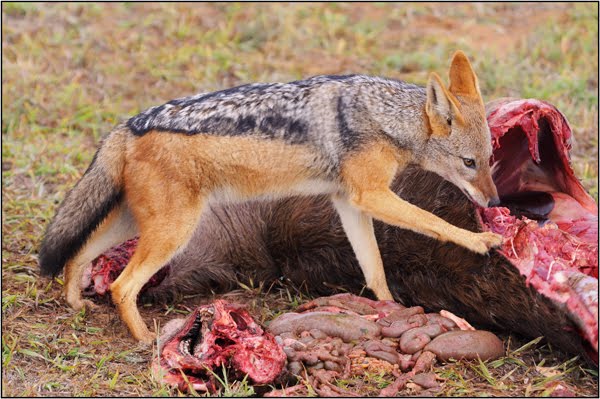
During the course of our fist night here, some hyenas had killed a kudu cow on the verandah leading into the Manor House en route to breakfast. It was considered bad form to leave the carcass here so that people had to step over this to get to breakfast, with blood and entrails making footing decidedly unsafe, so the carcass was moved to the open area about 500 metres from the lodge. Now breakfast was enjoyed with the carcass a mere speck on the plains, and some animal activity in evidence. This turned out to be Black-backed jackal, so after breakfast we made our way to the site for some photos. The jackals were more interested in the abundance of meat and took little notice of us. Of the hyenas there was no sight – these are the shy type, not the brazen hyenas of Kruger Park or Hluhluwe uMfolozi! Another interesting sighting was of a colony of termites coming out of the ground (what we know as “flying ants”). This caused a frenzy of feeding from various bird species, with about seven or eight different bird species enjoying this bounty.


Late one afternoon a lone jackal, obviously with a massive thirst from too much kudu, came to the waterhole in front of the lodge. After he had drunk his fill, he settled down for the evening. We were in the Manor House, when I heard an elephant trumpeting. I went out for a look, and twelve elephants at the waterhole had spotted the jackal. The younger ones were trying to intimidate the jackal, claiming the waterhole as their own. They were trumpeting at him, mock charging and in general just being difficult. This jackal was made of stern stuff, he would not budge, save to face up to the elephants. One of the younger ones then splashed water with its trunk at the jackal, but he stood his ground. The result, Jackal – 1, Elephant – 0. The elephants moved off, and the jackal stayed for the night. The next morning he was still there, when he was intimidated by a hyena. Again he stood his ground and the hyena eventually moved off without any blood being spilt.


There is no fence around Gorah, and when I was photographing our tent, I had the feeling that something was not right. Looking around, I came face to face with a buffalo (not really face to face, he was about thirty metres away), but I did the only thing I could do, I retired to the safety of my tent with supreme alacrity. The buffalo moved on, and then a lone elephant bull wandered past my tent, not in the least concerned with being fifteen metres from a human armed with a camera and with every intention to photograph him.

Gorah is an excellent destination and I would have no hesitation in recommending this to clients as a wild-life destination. Here I suspect one would be more than satisfied if you didn’t go on a game drive, as the activity around the waterhole in front of the lodge has more than enough to offer. The accommodation, staff, food and general ambience are second to none. They have an incredible road network for their sole use, and I doubt that we traveled more than one kilometer on any of Addo’s public roads. This means that one is not disturbed by the general public, and you can enjoy private sightings for a long as you wish. My only qualm, and please bear in mind that it is a personal preference, is that there is no electricity here. Lights are provided by candles, lamps and solar energy, which tends to be a bit dim if one wants to read in the tent. Who knows, the romanticism of candles may far outweigh this little gripe of mine, depending on your personal tastes.

Belvidere Manor near Knysna and the Drostdy Hotel in Graaf Reinet: May/June 2010

Two other one night stops that I made were at Belvidere Manor near Knysna and the Drostdy Hotel in Graaf Reinet.

The story of Belvidere begins in 1830 when the land was acquired by George Rex, the "squire and proprietor of Knysna" who settled here and became the foremost timber merchant in the district. When a young Scotsman named Thomas Henry Duthie married George's third daughter, Caroline, in 1833, he bought the farm named Belvidere from his father-in-law for £750. In April 1835 the young family, now with a first baby, named Caroline after her mother, moved into their cottage, which was situated where "The Bell" now stands. At that time it would have had timber walls and a rush roof and the cellar which now houses the wine would have been used as storage. By 1848, the family had quite outgrown the cottage. There were twelve children in all, and plans were made to build a larger house. Foundations were laid on 2 October 1848, and in November 1849 the family had their "first dinner out of New House". At that stage it was a single storey building with a thatched roof, dormer windows and small bell-turret. In its life, Belvidere House was an official post office serving the local community, with business being transacted from the glass door in the drawing room. It was a centre of gracious hospitality, welcoming every person of note who visited the Knysna area.


This venue also houses Knysna's smallest pub, The Bell Tavern, which is housed on the site of the original Belvidere farmhouse, and indeed a feature of the pub is the wine cellar viewed through the window in the floor, where freshly caught game would have been hung. With a yellowwood ceiling and ironwood block floor this is a cosy venue.


We stayed here in a cottage with bedroom and en suite bathroom, a comfortable lounge and kitchen, which can be used as a self-catering option.


The Drostdy Hotel is a living national monument. The foyer, with it's doors open, has a perfect view down the street to another national monument, Reinet House, one of 220 national monuments in the oldest town in the Eastern Cape and the fourth oldest in South Africa, Graaff-Reinet. Next to the swimming pool area is Stretch's Court, which is a cobblestone street, lined with colourful shutters and bougainvillea. The imposing slave bell reminds of a time when these cottages were emancipated slave quarters. Each and every one of the 51 rooms varies in size, shape, and decor. All are en-suite, equipped with air-conditioning and all modern day amenities to ensure a luxurious stay.


Graaff-Reinet has a rich history which is depicted in the many museums, a plethora of century old indigenous Karoo architecture and a visit to the Valley of Desolation should be undertaken by every visitor to experience the awe-inspiring rock formations and the splendid view across the Plains of Camdeboo.

Samara Private Game Reserve : May/June 2010

My last visit was to the venue that I was really looking forward to, the Samara Private Game Reserve, which is about 35 kilometres from Graaf Reinet. Heart-stoppingly beautiful, is how award-winning Samara Private Game Reserve in the Eastern Cape, has been described. I was really keen – I had visions of aardvark, herds of springbok, eland, mountain zebra and more. Nestled on the breathtaking Plains of the Camdeboo, Samara Private Game Reserve is proud of its unique heritage. The unique historical tales of Samara date back as far as the late 1700s, beginning with the world famous and extraordinary ornithologist, heroically named Francois le Vaillant. After having arrived in Cape Town in 1781, le Vaillant had only the clothes on his back after the British destroyed the ship on which he was traveling. With the generous assistance of Colonel Gordon, he set forth on the long journey inland. Upon reaching the vast open Plains of Camdeboo, le Vaillant set up a fortified camp on the Plat River, which runs through Samara Private Game Reserve.


The lodge is stunning and we stayed at the Karoo Manor, in one of their three Karoo Suites. The three Karoo Suites are individual Karoo style cottages in the garden and each has a luxury en-suite bathroom, is air-conditioned and has a fireplace. Echoing the pulse of the Karoo, the interiors seek to fuse the elegance of luxury colonial era with the untamed beauty of the African bush. Cradled in the softest linen, one gets lost in the sleepy rhythms of the land and the tranquil sounds of the Karoo. The Karoo Manor has complete wrap-around verandahs, many spacious rooms and roaring log fires. Boy, did we need those fires!


The night before we had stayed in Graaf Reinet, and a heavy downpour, thanks to a extreme cold front moving through the country, had occurred during the night. The morning sky showed patches of blue and I had high hopes for good weather. We reached Samara before lunch and there were more blue patches in evidence. That afternoon we went on a game drive and it was very cold, but with less and less clouds in the sky – my hopes were soaring. We saw some kudu, gemsbok, Burchells zebra, duiker, monkey and baboons, as well as some white rhino. All I wanted was aardvark! Our ranger tried his best, but we were just unfortunate, no aardvarks were seen on that drive. What I did see was many, many aardvark burrows, testament to the numbers of aardvark that must surely be here. Where were they?

During the night I heard the unmistakable roar of rain on our roof and we awoke to a very, very cold morning with very fine rain and mist. Remember, this is the Karoo – they are not supposed to have rain in winter and only a little in summer. Maybe no-one had told the weatherman? I went on the morning drive, up a stunning mountain track and onto the escarpment overlooking the Plains of Camdeboo. This track reminded me somewhat of the Sani Pass in some ways. Now we get to the top of the mountain and what happens? The skies open and the bitterly cold rain comes thundering down. Cameras are protected as best they could, animals, and there were animals, black wildebeest and mountain zebra, are lost in the mist. The Plains of Camdeboo are not to be seen and I have to take our guides word that they were in fact below us. We’re now fortified with hot chocolate and Amarula and we head down the mountain, freezing and wet. What happens next cannot be blamed on the weatherman. Two buffalo are on the track in front of us. I desperately want to get back to the lodge to dry off, dry my camera and enjoy a roaring log fire, but am hampered by the presence of these two buffalo bulls. They cannot go off to the left of the road, it is too steep and they will fall to their deaths down the mountain-side, they cannot go right off the road, it is to steep and these are not klipspringer! So now we follow them down the mountain, them plodding ahead and us freezing behind. Every time the ranger thinks he can sneak past without bumping them or nudging them to their deaths, one or the other turns around and gives us “the stare”, so we back off. Eventually we reach the bottom and the buffalo are able to get off the road and we are able to reach the warmth of the lodge.


Sadly, the rain did not let up, and if anything, it got colder and colder, so I missed both that afternoon and next mornings’ drive. During breakfast on the day of our departure, our ranger bravely set out to find cheetah for us, and located one in thick bush (yes thick bush in the Karoo!) which he offered to take us to. I politely declined his kind offer, as this would have meant going out in the rain, leaving the vehicle and walking up to the cheetah in the cold and wet, being hindered by wet vegetation, to see this animal. I still had to get to Bloemfontein in one piece with my health and good nature intact!

Maybe one day I’ll have the opportunity to visit here again – I would love to do this in good warm weather as this really is a stunning lodge which has magnificent suites and a very lovely Karoo Lodge.