Tuesday, December 21, 2010

Zululand, December 2010

I recently accompanied two clients on a 5-day tour, visiting the Hluhluwe uMfolozi Park, Mkuze and St. Lucia. Now there is only one reason that I am posting this blog, and that is that I have some photographs to go with it. (I do not normally take my camera on tour during the summer months – it is too hot to be carting equipment around, and when I am hot I am uncomfortable and I lose my enthusiasm for photography), but on this trip I made an exception. Why? Well, some of the time was to be spent in Mkuze, and I know how productive the hides here can be, plus the fact that they have recently released wild dogs into this park, so who knows, maybe I would get some decent photos of these most endangered of predators… but this was not to be, but more of this later.

We arrive at the Hluhluwe/Umfolozi Park at about lunch-time and head up to Hilltop Camp to enjoy lunch and then check in. We seat ourselves outside and I hear a faint sound of leather slapping against leather. Upon cautious inspection I see a bull elephant just outside the restaurant perimeter, enjoying a drink from the kitchens’ water run-off. (The slapping of leather was his ears flapping against his body). It was not a good idea to take the clients for a closer look, as there is no barrier between the elephant and us, so I take them inside the restaurant and look down on this animal from above. He is so close that were one so inclined, you could almost leap out the window and onto his very broad back, but we don’t do this! This was certainly a good introduction to the park and the clients were hoping for more.

That evening they went on a night drive, and reported that they had seen one elephant in the distance and quite a few rhino, but nothing more exciting than this. Unfortunately this seems to be par for the course in this park, as many people come back from a night drive without having seen any sign of the big cats, which is what the night drive is mostly about. (As an aside, why is it that the night drives in the Hluhluwe/Umfolozi Park are so much more expensive than the drives in the Kruger Park? The drives in the Hluhluwe/Umfolozi Park are 40% more expensive than Kruger, and the quality of drives in the Kruger Park are way better. Kruger has more roads, more comfortable vehicles, generally better sightings, etc. On this presumption, Hluhluwe should be less, not more expensive).

The next morning I took the clients out at 05:00, and the first animal we encountered was an elephant. This was a big bull, in full musth, and walking in the middle of the road towards us. He was not overtly aggressive, but he made it quite plain that he had right of way, and would not get off the road. Every now and then he would feed on the trees and bushes lining the side of the road, and just when I deemed it safe to sneak past him, he asserted his right to the middle of the road. This little game went on for about half an hour, until he eventually found a tree about ten metres from the road and I was able to continue my journey.


We went along to the Seme area of the park and it was at the Seme turn around point where we saw two lionesses, very well hidden in the long grass and bush. I asked the clients to be patient, as they would move, sooner or later. The sun was up, and the temperature was warming minute by minute. About ten minutes later the one lioness did get up, stretched and sauntered toward the road and the direction of our vehicle, soon to be followed by the other. Luckily for the clients, the lions were on their side of the vehicle so they could get some good photos of them. I on the other hand had to be content with a “grab-shot”, which is not ideal, but then, I was the guide, not the client, it’s not about me! Both lionesses disappeared into the bush near the waterhole and we continued our journey. We duly returned to Hilltop Camp for breakfast and proudly marked our elephant and lion sightings on the sightings map board.

After breakfast we continued on another drive and saw only general game. It was by this time quite warm, with the outside temperature showing 36º C. This drive produced zebra, nyala, impala, and many giraffe. At about 14:00 the weather changed dramatically and became very overcast and windy. When we left on our afternoon drive a light drizzle had started to fall, and a few flashes of lightning were visible. I decided to head south on the main road, as far as time would allow, and then return on that road again. On the way back it was already starting to get quite dark when we saw another lion, again in long grass. This was a youngish male, and he was calling. No great roars, just an almost apologetic call to contact the rest of his pride maybe? We watched for a while, but it was dark and I decided to move on. About 300 metres further down the road we came upon another young male lion, heading in the direction of the first one, and on the road - obviously the call had worked. I took a photo or two of the second lion, with a very high ISO of 3200 and the on-camera pop-up flash – the results speak for themselves, but I had to have evidence of a lion!


The following morning on an early drive on the Gontshi Loop we stopped to look at some buffalo on the side of the road. In the distance on the road up ahead I saw movement and realized that this may be lions, so off I went. It was lions, in fact eight of them, but alas; they were shy and soon disappeared into the long grass without a photo being taken - these were four females with four sub-adult cubs. For the Hluhluwe/Umfolozi Park, it is quite unusual to have three different lion sightings in two days, all in the Hluhluwe area but in different parts thereof. Had this been the Kruger Park, it would not have excited me as much, as one may sometimes have as many as four different lion sightings in a day, but for the Hluhluwe/Umfolzi Park, very unusual. My client indicated that he would dine out on these lion sightings for quite some time. That same drive we were entertained by a troop of baboons, so quite a busy morning and well worth the early start. The remainder of the day provided nothing more exciting than general game, and that afternoon we headed for the Ghost Mountain Inn in Mkuze. What a lovely hotel, thoroughly good food, offered as a choice of starters, mains and desserts and well received by our clients.

Now the next morning was what I had hoped would be the highlight of the trip, the Mkuze Game Reserve. En route to the Kumasinga Hide we saw plenty of impala with their young and some zebras, but we did not want to waste too much time, hoping to have an abundance of wildlife sightings at the hide. Upon arrival I noted that the water here was plentiful, both at the hide and generally in pools and pans throughout the park. We settled in, cameras at the ready, to commence photographing to our hearts content. One and a half hours later we had photographed a solitary wart hog that had come down for a wallow. Other than this wart hog, there were also common birds, laughing doves, black capped bul-buls, blue waxbills and some striped swallows. That was it – one and a half hours for this! We decided to go on a drive and look for the animals. All other hides, other than Kumasinga, were closed to the public, and this included the two on Nsumo Pan. Was this because of high water levels or plain disrepair, I’ll never know? On the drive we again saw many impala with their young, some zebra and some nyala, and that was that, so we left for St. Lucia, hoping for more on the Eastern Shores.


However, we were again disappointed. The Eastern Shores produced many kudu, some zebra, waterbuck, bush buck, a white rhino and samango monkeys. Wait a minute: “again disappointed”? No, this was actually a good 3-hour drive. My client was certain that he had seen a cat-like animal dart across the road. Unfortunately I was looking behind me at some open spaces, hoping to spot elusive game, whilst driving (…please don’t try this at home) so had not seen it. His description was for me that it was one of two things, either a young or female leopard, or a serval. However, the grass was so long that the animal had disappeared, so I could not confirm anything. Don’t worry, we spent some time here trying to find this animal, which, had it been a serval or leopard, are both supremely successful in hiding themselves.

One the boat cruise on the lake the following morning, many hippo were seen, some crocodiles, varied and many forms of bird life, so in short, another normal day on the lake.


Saturday, November 27, 2010

Umzolozolo Lodge - Nambiti Game Reserve


With great interest Lana and I left Durban for the 3 hour drive to the Ladysmith area and the relatively new Nambiti Game Reserve and Umzolozol Private Safari Lodge - Malaria free and technically a Big 5 game reserve – the leopard are extremely elusive here, in their stead cheetah are seen regularly. A pleasant drive to the midlands of KwaZulu-Natal, with some roadwork delays, we were in the parking lot, shaded bays and security, awaiting our Game Ranger and lift to the Lodge. A short 10 minute drive and we arrived to a welcome drink, lavender scented hand cloths and smiles all round. Our bags were dispatchour suite whilst we took a quick look at the beautiful vista from the Lodge. Set on top of a hill nestling ed to in discreetly amongst the beautiful old Acacia trees, the view out over the Nambiti Game Reserve is really delightful. Rolling hills disappearing in the haze, I could sit here all day with my binoculars looking for the host of animals and birds visible from the deck.


We were then escorted to our beautifully appointed airconditioned suite – huge double bed, dressing room, expansive bathroom and then a double outside shower as well. From our veranda, a secluded path took us to our own private viewing deck with Jacuzzi – set at just the right temperature - ideal for Honeymooners and old fogies like us.


The décor, in lovely bold reds with black and the orange of the African Hoopoe (Umzolozolo) part of the theme, all put together rather tastefully. It's not about the bathroom only, what a lovely view!

Some lovely African artwork and fittings add so much to the feeling of being in Africa in the bush. A lot of thought and care has been put into guest comfort. A 2 way radio connected 24/7 is something I have not seen at any facility that does not have telephones in the rooms. An excellent safety feature.

Back to the Lodge for lunch. A beautiful steak dish done perfectly to order followed by a banana turnover dessert. Whilst enjoying our freshly ground coffee our hosts presented us with the dinner menu with the choices for starters, mains and dessert. As one could return fairly late from the afternoon game drive, such forward planning in the kitchen is such a good idea. I know I was anticipating my snail starter, lamb shank and chocolate mousse with glee. Time for a quick swim whilst viewing the bushveld below – numerous Kudu and Impala visible - a cup of tea with fresh baked biscuits and we were into the game viewing vehicle with our guide Bradley giving us a quick rundown of what was to be expected. I must add that the safety procedures sounded more like a Kulula.com briefing – quite hilarious besides its importance. We were to enjoy and learn a lot from Bradley.

The topography of the Nambiti Game Reserve is quite diverse with some very hilly and scenic areas contrasting with the northern plains, a wonderful open flat area for the grazers. Hippo in the dams, kudu around almost every corner – these antelope are really numerous in this game reserve, I have never seen so many. Then impala aplenty, giraffe, zebra, eland, common reedbuck, black-backed jackal, buffalo , steenbuck, hartebeest and grey duiker all seen during the afternoon drive. We stopped for a sundowner drink, stunning sunset, and then, before it got too dark, Bradley was determined to find lion for us. He had heard lion calling and we rushed off – ‘eagle eyes’ one of the guests on the vehicle soon spotted a lioness not too far from the road.


As we stopped, she started calling, what an impressive sound the call of a lion right next to your vehicle is ! From somewhere, just across the nearby river, came an answering call. Close but we could not spot him. Then way off on the far hill we saw this magnificent blackmaned lion approaching. His call had seemed so close. Well he did come close and he did call again. One had the feeling that the walls of a nearby abandoned kraal would come tumbling down like Troy of old, such were the reverberations – awesome. Bradley let us know that these two lion had been seen mating – they decided to await our departure, so we missed the often rather aggressive copulation.


Darkness and a nightjar, an owl, some of the diurnal animals which Bradley was careful not to temporally blind with the powerful spotlight and we were eventually back at Umzolozolo. Scented cloths to wipe away the dust and grime and we hastened to freshen-up returning to the comfortable veranda for drinks, recounting the afternoon sightings and dinner. My anticipation was rewarded with a most delicious meal and good company. What a super day.


I awoke to the roar of lion emanating from the valley below our chalet. A fairly early start produced some really excellent game viewing. I was very impressed with the diversity and quantity of species seen. Along with those seen the afternoon before we added blue wildebeest, mountain reedbuck, waterbuck, a lone black wildebeest, white rhino, Blesbuck, water monitor lizard and then an antelope from the western side of our country, gemsbok.


We found 2 female lion on this sojourn as well. Bradley pointed out various birds and some super sightings were had, even a pair of the rather scarce Black Harrier and some eleven Blue Cranes with chicks, our National Bird, these also becoming “threatened” in RSA. He would also stop for us to smell and taste some of the bushveld herbs, interesting and adding to our enjoyment. Nambiti Game Reserve is yet another area rehabilitated from not really viable cattle and sheep ranches. It is also part of the local African community land, now being utilized to maximize the benefit to these folk, with them getting a return from the Lodges / visitors. Many are also employed at the various Lodges in the Game Reserve. I found it quite evocative driving through the bush and coming upon a stone covered grave with an old Ziziphus mucronata - Buffalo Thorn tree growing from the head of the grave, was this part of Zulu custom, to take a branch of this tree to where the person died, this thorn tree brings back the spirit to the grave?


We returned to the Lodge for breakfast, extensive, leisure, lunch , individually baked chicken “pies” each in own deep ramekin dish with a crusty topping followed by an apple dessert, leisure and then once again out into the bushveld. Management of the Nambiti Game Reserve have decided to dehorn the rhino, hoping to save them from the present spate of poaching. The reserve has already lost two. I was getting my bush eyes back and was really enjoying the environment, the company and Bradley kept adding value to the drive as he carefully negotiated some very rough and bumpy sections. We had a rather grumpy old Buffalo ask us to depart the area immediately. New one for me to have a Buff go for a vehicle. Bradley never let him exert his will too strongly and left as soon as this cantankerous bull started advancing on us. The Park strategy to hopefully cure the old boy of his wayward intentions. That evening after dark another lioness in the long grass – what a days game viewing.

The weather was a bit changeable so dinner in the Boma was not an option although this is a popular venue for the evening meal, all seated around a fire under the stars. In compensation we were treated to a breakfast out in the bush. A lovely setting next to a dam with the odd antelope wandering past. The catering staff had preceded us to the site, set up the venue and prepared a full breakfast, a lovely end to our visit capped only by venturing off-road on the way back to the Lodge to find the two lioness in repose for the day in the shade.

Umzolozolo Private Safari Lodge is a particularly wonderful wildlife destination.

Our hosts made guests feel welcome, relaxed and really comfortable, or was it the décor, furniture and fittings. The standard here is high.

The staff were particularly unobtrusive but so attentive. One felt like you had your own private butler.

The game viewing was better than expected or were we exceptionally fortunate? It might have been out of the norm to have lion sightings on all four game drives, but for the rest I believe this would be what one could expect. I really would like to revisit Nambiti Game Reserve at a different time of year – late summer and winter, to really asses this wildlife venue that so far is a wonderful, affordable alternative to our KwaZulu-Natal provincial parks and what’s more it’s Malaria free.


This beautiful reserve is also so well situated, between Johannesburg and Durban, close to the Drakensberg Mountains and there is history here too – battles between Boer and Brit within the Park boundaries and remnants of early Zulu habitation. There is more to explore here, we will be back!

Monday, November 8, 2010

Tour: Hluhluwe uMfolozi and Kruger Park – October 2010

So, there I was, on tour again at the end of October, this time to the Hluhluwe uMfolozi Park and then onto the Kruger National Park with two clients. We began with a boat ride at St.Lucia where the clients had wonderful sightings of hippos (as usual), crocodiles and an African Fish Eagle, very close to the boat. This was quite a windy day, and the eagle was not too concerned with flight, preferring rather to pose for all and sundry. As is the norm, there were also lots of other water birds to be seen.
We then entered the Hluhluwe/Umfolozi Park and en route to Hilltop Camp saw lots of general game – and I am now including elephant and buffalo as general game in this park, because they were seen so often. Oh, what the heck…I am also including white rhino in this category, as many of them were also seen. On our second day here, we had to wait for two elephants to move away from the camp exit gate before we could proceed with our early morning drive. One of our memorable sightings was of a herd of about forty elephant down at the Hluhluwe River, just below the Sitezi view site - and they were there for quite some time. On the Lower Magangeni Road there was also a yellow-billed kite, which, because of it being early morning, emulated the fish eagle of the day before and preferred to pose rather than fly away. (Raptors are a bit lazy to fly if they have to flap their wings too much – they prefer to soar on the warm thermals, which are not present in the early mornings). Alas, the light was poor, so I didn’t take any photos.

We returned to Hilltop for lunch, and from my chalet, not too far away from my window, about 40 metres away in fact, I see this large elephant bull trying to get at some of the surface water, which is from the run-off of the kitchen. He was quite content, and stayed there a while before moving off alongside the camp fence. (Just as an aside, I also spoke to my neighbours, a Dutch couple, at this time, and who were in the chalet next to mine. I also noted that their rental car had a large piece of paper taped to the steering wheel, with one word on it: “LINKS”. This word translates into English as “left”, which tells me that this person now has a constant visual reminder to keep on the left side of the road when driving in South Africa!).


The next morning after breakfast we set off from Hilltop and traveled through Swaziland’s eastern section, stopping for lunch at Komatipoort, before entering the Kruger National Park. We checked into Lower Sabie at about 15:00 and went for a short drive, having only one and a half hours before we had to be back in camp before the gates closed. In this short time we saw two herds of elephant, a male lion just off the road and a leopard in a tree, a fair distance from the road. All of this just on the main road next to the Sabie River! We also did a game drive in the Lower Sabie area the next morning before breakfast and saw lots of general game, a hippo asleep next to the road and four lions on the Nhlanganzwani Dam wall, again a fair distance away.


After breakfast we headed north towards Satara, and just after Tshokwane, we came upon another group of lions. These were quite far away, but I reckon that there were about six or seven of them. About two kilometers after seeing this pride of lion, we chanced upon another leopard, this one also in a tree. This chap was asleep, with his rear end facing us (and I think I may one day publish a coffee table book, “The Rear Views of Africa’s Animals”). Anyway, we stayed watching him, as he did appear to be a little uncomfortable. I then saw three kudu on the other side of his tree, heading in our direction, with the leopard between them and us. The leopard then sensed their presence and turned around, which is what we wanted. He then showed great interest in the kudu, which at this stage were still blissfully unaware of his presence, until they were almost directly under his tree. They then realized he was there and burst into a chorus of alarm calls, leaving the scene in a bit of a hurry. The leopard lost interest, (these were adult kudu – what could he do?) and settled down again, in almost the exact spot and exact pose, i.e. with his rear end facing us. It was at this point that we too left the scene.

Lunch at Satara produced a herd of buffalo at the waterhole just outside the fence, soon to be followed by four elephant bulls – ho hum, more general game. They did not disturb my lunch, and stayed there for quite some time. I then wandered over with my camera, just as they were leaving the waterhole. Maybe they sensed that I was someone who has yet to take a decent photo of an elephant, so they then proceeded to cover themselves with sand and dust in a show of activity. I don’t understand how an elephant can take so much sand and dust up its trunk, blow this all over them, and not sneeze! Am I missing something? Anyway, I took some photos, but I still have a long way to go before I get a decent photo of these magnificent animals.


That evening there was a civet at this same waterhole, but this animals decided to leave the site, probably due to the arrival of a spotted hyena! One does not see civet often, so this was quite a bonus. On getting back to my chalet after dinner, there was a honey badger on the prowl, and this chap was busy systematically turning over dirt bins in the hope of finding some food. When he came to my bin, I encouraged him to leave, and this I did by clapping my hands loudly, from behind the safety of my stoep wall. He took my threat seriously and by-passed my bin, happily foraging further on.

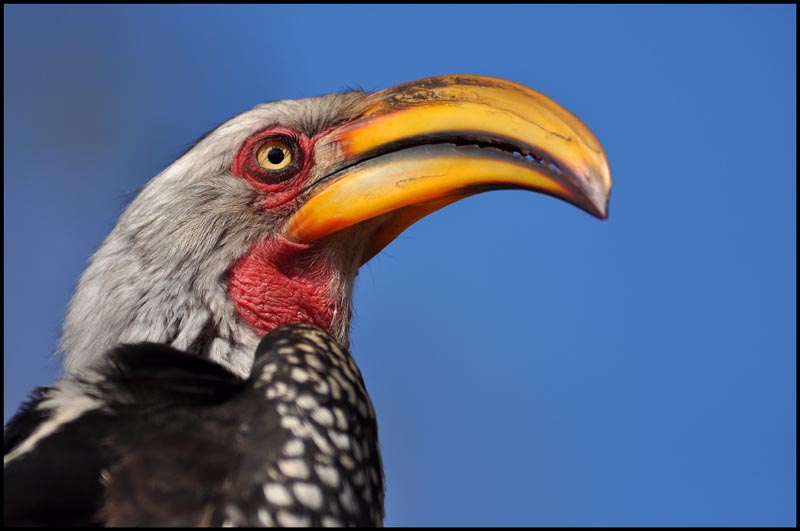
The next day the clients did a guided walk, so I took the opportunity to do a game drive by myself, but just as well the clients were not with me, as I hardly saw anything. What I did see were some yellow-billed hornbills, and one of them had caught some big blue insect, so I took a couple of photos of this. After they had returned from their walk we took a drive on the S100, which produced a pride of lions. Unfortunately there were quite a few vehicles about, so I could not get a clear shot of them and they eventually disappeared into the thick bush. That afternoon we went for a drive as far as the bridge over the Olifants River where one is allowed out of one’s vehicle. A yellow-billed kite flew quite low over me and I banged off a photo or two of him. He then landed on the bridge railing, so I thought I would try and get as close to him as I could before he flew off. I walked closer and closer to him, stopping every step of the way to take his photo, in case this should be my last. The next thing I knew I was so close to him that I was shooting just head and shoulders of this bird! He was turning his head in that quizzical way that birds and dogs have, wondering what all the fuss was about. I was happy with what I got, as were the clients.


En route from Satara to Skukuza the next day we saw a pride of eleven lions, and lo and behold, another leopard in a tree, close to the road. This animal was in a deep sleep on a thick branch, so not much of him was visible, but it is always exciting to find a leopard. Before we had reached Skukuza, we came upon another pride of five lions and then for the remainder of the day, lots of general game (and remember I am including elephant and buffalo in this term “general game”)

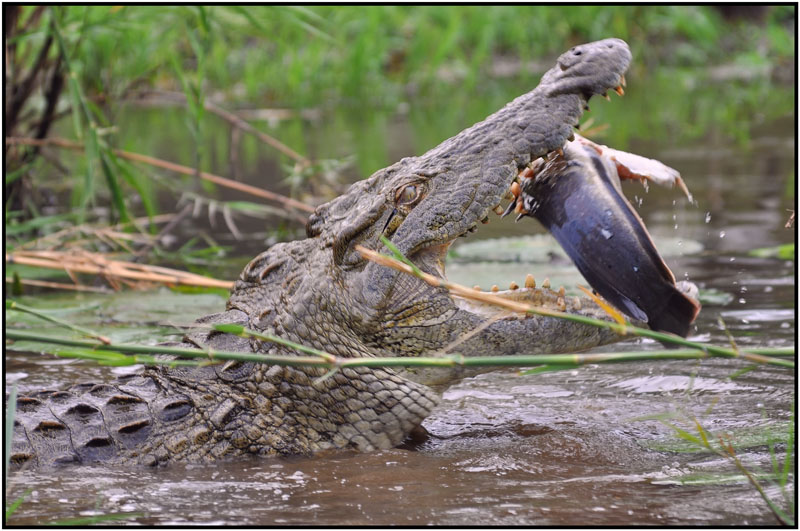
The last day we left the park fairly early as the clients had to get to Johannesburg in the early afternoon. On the way out I stopped at my favourite spot in the Kruger, Lake Panic. I did not expect too much here as it was early, just after 06:00 and not much was expected to happen. There were some green-backed herons flying about, a grey heron, some kingfishers, hippos and some crocodiles that were floating lazily in the still water. One of the crocodiles then came to the edge of the water, and caused some disturbance - and this disturbance was caused by this crocodile catching a barbell! The next second birds came from all over, screeching in bird language at this poor crocodile, which totally ignored their verbal assault. The grey heron actually ran to the crocodile, as it was that close to it, two green backed-herons flew in from who knows where and a squacco heron appeared from out of the blue. The other two crocodiles also made their way to this lucky one. I had never seen this behavior before and was quite surprised that the birds would go this close to a crocodile to vent their disapproval. Anyway, the crocodile proceeded to arrange the fish in its jaws so that it eventually went down its throat, head first, never to be seen again.


Just before we exited the park we came upon some ground hornbills and I managed to get a pretty poor photo of one of them throwing a small frog up into the air and catching it – again, the frog was never to be seen again – all over in a few short seconds.


At this stage I have to confess that I have not included all the wildlife sightings in this article – this will just take up too much space, but be sure that we saw many, many animals and birds on this trip. In fact, the clients commented that they had not expected to see so much. It was a pity that the lions were just too far for any decent photos, or then so close that some cars in the photo would have spoiled it. People generally still want to see lions and they are viewed as a special sighting. They are, aren’t they?

What can one say about these two parks? I am often asked which my favourite park in South Africa is, or then which is my favourite park between the Hluhluwe/Umfolozi or Kruger Parks, and I now have to say that it is Kruger. Although the Hluhluwe/Umfolozi Park can be good, your chances of finding lion and leopard are not as good as in Kruger. You would also be traveling over the same roads if you stay here longer than two nights, whereas Kruger is so big, that you don’t have to do the same road twice. However, the food in Kruger cannot be compared to Hilltop – Hilltop has a much better selection, is better prepared and the staff are more efficient. Why can’t Kruger get it right when it comes to catering? Imagine if they outsourced their restaurants to a company with a proven track record in South Africa of actually running family type restaurants at a reasonable price – how good will that be. “So folks, where shall we eat tonight? Spur or Nandos? At the moment it is dry, overcooked chicken or pork and very overcooked vegetables, with some tired salads as a distraction. Maybe one does not go to the Kruger Park for their culinary offerings but for their wildlife experience? Why can’t it be both?

Wednesday, November 3, 2010

Madikwe Safari Lodge


Madikwe Game Reserve. October 2010
I have been wanting to visit the Madikwe Game Reserve for a number of years. Situated in North West province and on the Botswana border this recently protected area hosts a rich diversity of species. Something any keen wildlife enthusiast should really appreciate, and it’s Malaria free.
Semi-arid Kalahari bushveld with a broad mix of habitats and diverse geology sustains species not found or easily seen in the eastern game reserves of South Africa. Springbok, gemsbok (oryx), brown hyena, bat-eared fox, African wild cat, tsessebe, red hartebeest and eland were the special species I was keen to see along with the Park’s reputation for excellent sightings of Cape wild dog and black rhino.

Enthusiastically, Lana and I packed our camera equipment and a mix of clothing to cater for the changing season. We were not sure what the weather was going to be like? So possibly something warm enough for the early mornings / evenings and cool clothing and hats for the heat of the day.
An early flight out of Durban to Lanseria Airport, Johannesburg, had our hosts waiting to collect us at 07h30 for the 3,5 hour drive through to Madikwe Safari Lodge, our home for the next three days.

Madikwe Safari Lodge consists of 20 suites - divided into three camps. The larger 12 suite east camp, the 4 suite north camp and then the intimate 4 suite west camp ‘Villa” that should be booked by one party at a time. Brick under thatch with high ceilinged public areas made for delightfully cool rooms open to the lovely shimmering vistas over the bushveld and to the Dwarsberg Hills in the distance. 


Delightful lunch, relax – a massage? and then back for refreshments, teas and cake before heading out on the afternoon game drive. Marc, the head ranger and guide for the duration of our stay, gave a security briefing and short description on how in early 1991 “Operation Phoenix” swung into gear and the largest translocation of wildlife ever, commenced. Since then some 12,000 head of game , 28 different species, have been reintroduced to an area where farmers struggled to raise their crops and cattle.
An environmental impact study had been undertaken that showed that wildlife based tourism was the most beneficial option for this remote and economically depressed region. It certainly appears to be the case and expansion to the 67,000 ha reserve is already being implemented and further numbers of specific species are to be added. What exciting news. This is a special place.


The Rangers here have such a wide rounded knowledge of the bush and its inhabitants. Not only the wildlife but occasionally we would stop at some interesting herb to smell and feel. Sage never smelt as good. Care too is taken that the guests are as best aligned for photographs. Marc, an accomplished photographer added value and assisted for aspirant photographers with comments like “make sure you don’t cut off his tail in the picture” and such !

Madikwe Safari Lodge has chosen ‘open’ Toyota Landcruiser game drive vehicles, which were really comfortable with individual bucket seats for guests. So with bottles of water hastily grabbed from a large ice-filled ‘cooler’ we climbed aboard, cameras and binoculars at the ready and we were off. Along with management controlled burning there had been a fire caused by a lightning strike which had burnt ‘hot’ and affected quite a large area. The rains had barely begun and consequently only small sprouts of green were visible – dramatic countryside! Despite the burn, many of the animals seemed to favor feeding on the blackened branches. It seemed the fire had created toffee-apple like flavoured foodies which the elephant and black rhino in particular, seemed to relish.


Storm clouds in the distance, an eerie silence and something was up. The animals seemed to sense something was awry and were not as visible as we had hoped for our first drive. Having said that, a number of antelope, zebra, buffalo, baboon, jackal and warthog were all seen before Marc decided it was time for “sundowners”. A stretch of legs, a drink and the bright orb settles in the west. Something about the sunsets here - I remember from my numerous visits to the Botswana game parks just over the border -how the sunsets there were just so amazingly red. Madikwe too has this good fortune, is it the richness of the Platinum in the area, the Kalahari red soil dust?


Darkness, stars and a spotlight to find the nocturnal species. Our ranger, would use a red filter over the light when viewing the animals, particularly the diurnal species and was careful not to shine in their eyes. It could temporarily blind them somewhat, long after we had left them, and this could compromise their safety. A spotted hyena on the prowl, then an African wild cat. I hadn’t seen one for ages, super! So close and unconcerned, on the hunt. A barn and then a spotted eagle owl too. Slowly back to the Lodge and dinner. We arrived back to fresh face cloths for a quick wipe down and a delectable cocktail? Gin Fizz ? Why not?

We were ushered through to an enclosure just beyond the lounging areas and there roaring fires, a huge barbecue and much lively chatter greeted us in the boma. Drinks all round and we settled down to our feast under the stars. Starters and mains, what with braaied fillet and chicken done to perfection with veggies and all necessary accoutrements . This followed by the staff singing for the guests. Such harmony and enjoyment. Imagine ending with a divinely decadent chocolate tort – it did not take much to lull us to sleep that night.

In anticipation of the early morning game drive offerings, had us bathed and dressed before the security proffered his wake-up call knock on the door. Packed our gear and off to the main Lodge. The bush lining our path was alive with birdlife, all seemingly trying to outdo the next, what an awesome chorus. So many calls reminiscent of past visits to Botswana and some new ones too. Freshly squeezed orange juice, teas, coffee biscuits and rusks readied us for our morning sojourn into the bush. Marc was there bright and early, rifle and vehicle clean and ready.


We departed slightly after the other vehicles only to hear that they had found a pack of wild dog on a kill. As the number of vehicles at a sighting is limited Marc chose a slight detour in order to get there once the first vehicles had had their fair share of viewing. How advantageous, right there next to this winding track through the burnt bush was a black rhino and her calf. Her head stuck deep in a delectable Sicklebush chomping at the fronds did not produce the best of photographic images but the calf was active and made up for this. Eventually our presence was felt and off they trotted. We trotted off to the wild dog and what a super sighting. A pack of 5 adults and some 5 healthy pups who regularly squealed and called for the spoils of the kill to be regurgitated for them.


While we were watching this lot, a brown hyena snuck up and then settled down watching the energetic interaction – hoping to secure some discarded tit-bit? Then a small breeding herd of elephant hastened past whilst the pups put on a brave show of hunting a flock of helmeted guineafowl who voiciferously challenged their approach.


An so the day went by with some rather excellent sightings, smells and tastes. Marc was regaling us with the history of the region, early and middle stoneage artifacts have been discovered in the Park. Then let us know that he and some rangers had discovered some ancient food caches, still in the clay pots, secreted away in the inselbergs to the north west. Well that made for an excellent afternoon game drive destination. Out across the open plains with sightings of springbok, gemsbok , a pride of 5 reposing lion, along with other antelope and giraffe, warthog and zebra. Geomorphogically the inselbergs are not as expected and are actually a mass of jagged boulders. Amongst this lot is where the caves and hidy-holes are to be found, an anthropologists dream. We were taken to some caves and there were the pots, mostly still intact. One can only conjecture as to what relics and secrets from the past are to be found here.

The sun was on its way to the horizon as we made for the nearby ‘amphitheater’ for sundowners. We marveled at how the rocks retained the heat absorbed during the day and now radiating out at an ideal temp for our sundowners, as overhead the clouds billowed and gathered threatening rain.

We had quite an interesting stop at a dam on the way back, where we found two black rhino sparring, 2 white rhino were in close attendance seemingly cheering them on with the flash of lightening doing its own sparring to Earth in the background. Further on and just before reaching the Lodge, the first of the rain fell, quenching some of the persistent fires still smoldering on the Leadwood stumps and a rather parched earth .

Dinner that evening was on the expansive deck at the Lodge. Candle lit and what a menu – even prawns in the bush. The Lodge certainly caters well and there is always an alternative choice . The Lodge house wines are really excellent too. This became a rather festive evening - thanks to security who escort one to the rooms after dark – a safety procedure at most Big 5 bushveld venues.

The following morning was clear and fresh with an exciting range of sightings, possibly jackal trying to secure their share of a lion kill, the highlight. A brave little fellow managed to sneak in and make safely off with a section of the lower colon from the zebra, which he proudly brought over to us, so that we could witness his enjoyment, much to the chagrin of the two large blackmaned felids.


Sadly we left this very friendly, professionally run venue. Our stay was over, but in that short space of time we had learnt so much, realized the game viewing potential of this special place Madikwe, and created a yearning to return and explore this rather divers venue further. I can see now why Madikwe Safari lodge enjoys such good game viewing as it is so well situated in the reserve and is so easily able to access the Park in all directions.
Thank you for a most rewarding few days in your care Madikwe Safari Lodge.
The region is also imbued in history and has seen the passage of Mzilikazi and a range of explorers, traders, hunters and missionaries, including Dr David Livingstone, Sir Cornwallis Harris and the famous South African author, Herman Charles Bosman. A copy of his Mafeking Road is to be found in each suite at Madikwe Safari Lodge. In line with &Beyond Africa’s vision, Madikwe Game Reserve is run as a joint venture between the North West Parks Board, the private sector and the local communities. &Beyond supports the local community and a village close to the Park. Their wildchild program allows students from these communities to experience an &Beyond Conservation Lesson on the reserve. Hopefully to become tomorrow’s guardian of Africa’s wilderness.

Wednesday, October 6, 2010

Kruger Park Tour, September 2010

I was fortunate to be the guide for clients who had decided to visit South Africa for the fifth time – and I had been their guide on the previous four occasions. These were very keen photographers, and I was in my element. Also, these clients were not focused only on the “big-5”, but were interested in every aspect of our wildlife on offer – so refreshing not to have to focus solely on only some animals! They had visited South Africa on the previous four occasions to take photographs – visit number five was no different. The only difference now between this visit and the previous ones was that they were even more discerning, so I had to keep in mind the light situation, the angle and direction of light, the time of day, and the placing of the subjects relative to this. The weather played along most of the time, but we did have overcast conditions on two of the mornings and very strong winds on one of the days. Photographers will know that lighting is the most important aspect for wildlife photography and for all forms of photography in general. The only negative (if one can call it that) aspect to all of this, is that this tour took place over the school holidays and the Heritage Day (or is it National Braai Day?) long weekend. Kruger Park was chock-a-block, with all camps full and day visitors at a maximum. These numbers of visitors notwithstanding, we had some good sightings.

We started off with three nights at
Skukuza and three nights at Satara – both good areas for game viewing in this very popular park. All the general game were seen, and including lion, many, many elephants, rhinos, buffalo, leopard, zebra, wildebeest, a whole range of antelope species, a variety of birds, etc. etc. In fact we saw lions every day, with more than one sighting per day, and on one day, as many as four sightings! Elephant sightings may have been a many as ten per day, they were so common. Compare this to some of our other parks in South Africa and one can see why the Kruger Park has such a reputation – one does not get many of these sightings in some of the other parks as you will regularly get in the Kruger. I tried to avoid the more busy tarred roads, as with this number of visitors, these were sure to be busy, so I stuck mainly to the lesser dirt roads, which were much less busy. In fact, on some of these roads we hardly saw any other vehicle at all, or else only very seldom.

- A visit to Lake Panic. Those of you who know me will know that this is one of my favorite spots in the Kruger for photo opportunities. This visit did not disappoint, and we had some amazing birding here. There was a grey heron in the nest opposite the hide with two chicks, and she kept us entertained for a long time, flying to and fro, feeding the chicks, etc. I was focusing on a goliath heron, when I heard both the female and her two chicks kicking up an awful racket. I looked up to see what all the fuss was about, and lo and behold, here was a female leopard below the tree where the herons nest was, and they were telling her in no uncertain terms that they had seem her and best she move off! The leopard took their advice and moved along the waters edge until she was out of sight. Unfortunately she was in the foliage and did not make for any good photographs, but how often does one see a leopard from a hide? The answer is of course twice – I had seen a leopard here about two years ago on another visit!


- One morning we had travelled on a quiet dirt road and had now joined the busy tarred road between Skukuza and Pretoriuskop, en route to Pretoriuskop for breakfast, when I was stopped by a guide in an open game drive vehicle. “Daar is ‘n luiperd drie kilometers af met hierdie pad” he says to me, which translates as “there is a leopard three kilometres down this road”. “Yeah, right” I think to myself. How likely will it be that this leopard, if there ever was one, will still be on the road, taking into account this guide’s three kilometers and my three kilometers of travel? Three kilometers down this road we come to a massive traffic jam, and the cause of this traffic jam is a magnificent male leopard! He is acting just as if he was in the Sabi Sands, he in unconcerned and disdainful of the many cars around. He is strutting his stuff in the middle of the road, with the odd walk to the edge of the road to mark his territory, before taking up position in the middle of the road again. The light is good, but unfortunately the setting on the tar road is not too good, but some close-up shots of his head are taken by my clients, before he wanders off the road and into the bush after a while.


- That afternoon we had some magnificent elephant, close up in very good, low light, and the clients were happy with this. Many shots were taken here. (I don’t bother with elephant shots too much – I have taken plenty in my time, but they are all just so-so, nothing that stands out, so I tend to leave them be as far a photos are concerned, let better photographers have them).
- The clients also wanted a good giraffe photo, with blue sky behind the animal’s head, as well as baboons. One game drive delivered on both, and this too was ticked-off the “to do” list.


- On our arrival at Satara, we saw a Scops Owl in a tree, perched low on a branch, very close to the reception area. This poor bird was being photographed from all angles, some photos being taken by people with their cell-phone cameras, so close was the bird! One could in fact reach out and touch him, but I suppose that he had had enough of people, as he was not there the following day. Good for him.


- One afternoon we went to the Sweni Hide, where there were some lovely yellow-billed storks and a number of waterbuck present. Again, nice light, so many photos were taken.


- The hide at Muzandzeni produced some lovely hornbill photos. There guys were posing in good light and seemed to enjoy showing off. Oh, and by the way, we were the only people there, so had the place to ourselves and spent the better part of an hour here. 


- At the Matambeni Hide just north of Letaba, I saw movement on the far side of the Letaba River. This turned out to be a crocodile that had either a bushbuck or impala in its jaws, and was now carrying this unfortunate animal with great difficulty to the water, where it would no doubt be having a feast. Unfortunately this was too far away for any photos, but what a sighting.


- That afternoon I was driving on the H7 to the west of Satara, where the bush had been burnt. This was a very windy day and we weren’t seeing much. Out in the burnt area I then spotted something tan, and upon closer inspection with binoculars, found that it was a caracal. This beautiful animal was totally relaxed, but just too far for any decent photos. The clients were happy; this was their first sighting of a caracal anywhere.


- On the way back to camp, just before the camp gates were to close, there was another massive traffic jam. Three male lions had decided to rest up next to the road. We did not spend any time here.


– the camp gates were about to close, and there were just too may cars. I joked that we would probably find them the next morning. And so we did! Upon leaving Satara, we came upon them at the intersection of the H1-3 and H6, boldly sauntering along the road, with a couple of other vehicles in attendance. Again, some nice photos were taken.


One has to temper a visit to the Kruger Park with the standard of the camps, the quality of the restaurants and the level of service of some of the staff, but all in all, this was a good tour, and I will certainly be back at the first opportunity.


With all these sightings and photographic opportunities that we had, there were some really good sightings that stood out:


- One really good male lion on the S21 towards Lower Sabie. He was coming from the left of our vehicle, and when he got close to the vehicle, stood still and posed for a while before moving off directly in front of us, with us being the only vehicle there. This was one of the mornings when there was no sun, so the soft light was not as dramatic as it could have been, but good nonetheless.

Thursday, September 30, 2010

Asara Hotel - Stellenbosch

Wasn’t I the lucky one recently?

I was invited to a Relais & Chateaux workshop that was held in Durban a while back. There were a number of member properties exhibiting at this workshop, all superb properties in South and Southern Africa. I always try and attend these events, as one is almost always bound to learn something here, and this event was no different – a property in the Kalahari, Tswalu, which I had always been interested in, had set out their programme for 2011, which I realized may suit some current clients. Two things immediately caught my eye – if you stay for four nights there is a complimentary air transfer to/from either/or Cape Town and Johannesburg to the property, and if you confirm three months in advance, you are guaranteed your own private ranger and vehicle. I have since discussed this with these clients and it seems as if they will be spending some time there next year.


But more than this – as is customary at the end of these events, there is a lucky draw, with some wonderful prizes up for grabs. One always sits down with hope, and there I was, hoping for a prize of some sort. Well, business cards were drawn, prizes were handed out, and the final draw was to take place, with my name still in the bottom of the hat, as it were. So, as you are now no doubt expecting, my name comes up last, and I have won a two night stay at the Asara Wine Estate and Hotel in Stellenbosch in a de luxe room, with a complimentary dinner at Raphaels for two, as well as wine tasting for two. 


This was great, and I made plans to get to Stellenbosch a few weeks later. What a wonderful hotel. Set on an enchanting, three-century old wine estate, Asara has risen over the past seven years to become one of the Cape's most exclusive Wineland destinations.
Guests can indulge in five-star luxury accommodation, fine wine tastings, superb service, and gourmet and casual dining. All facilities boast spectacular views, with their tranquil waterside setting, backed by the grandeur of the Stellenbosch- and Helderberg mountains and vineyards, providing an idyllic backdrop.


Our stylishly decorated de luxe room had its own private terrace which offered spectacular views over the vineyards and surrounding mountains as well as en-suite bathroom facilities. The bedroom was equipped with a fully stocked mini bar, hairdryer, satellite television, telephone, tea and coffee making facilities as well as an electronic safe, with a king sized bed. We spent the one night here and did a bit of sight-seeing in the Stellenbosch area the following day. Upon our return to the hotel the duty manager had bad news for us – there was a problem with the geyser, and we would have to move to another room. And which other room? The Avalon Suite of course.


Named after Asara's most prestigious wine, the Avalon Suite offers its guest a slice of opulence. The stylishly decorated suite consists of a spacious king sized bedroom with a large walk-in cupboard, a luxurious en-suite bathroom fitted with a jet bath, as well as a private lounge with an open fireplace. Its private balcony offers spectacular views of the Estate's well-maintained vineyards as well as panoramic views of the Stellenbosch and Helderberg mountains. It is equipped with air conditioning, a fully stocked mini bar, hair dryer, electronic safe, two satellite televisions and a DVD player as well as tea and coffee making facilities for your use. Bad news indeed! This was heaven.


That afternoon we did some wine tasting there. We had a choice of tasting five wines each, and these were not the puny little wine glasses so prevalent at other estates, but proper wine glasses. I chose four reds, and a noble late harvest to call it an afternoon – all good stuff. 


That evening it was dinner at Raphaels. Asara's main restaurant offers classic European style cuisine ranging from very easy and light snacks to the finest of dishes, using only the finest and freshest locally sourced ingredients, including seafood. The environment is relaxed and informal with a touch of elegance, perfect for enjoying breakfast, lunch or dinner on the estate. This was a superb meal, complimented by delicious desserts and what other than a bottle of Asara Shiraz.


Certainly a place to go to if one has the means.